
Palladas: The Other Half Speaks Out Part II
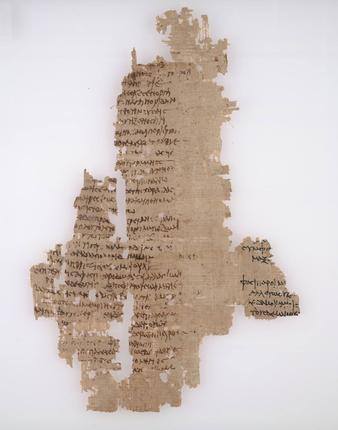 In the second part of this blog on my new versions of Palladas (see previous post), commissioned for a conference at UCL, I would like to move on to the poems from the newly-discovered papyrus. Due to their far more fragmentary nature, these were a harder, but equally, perhaps, a more intriguing task. That said, with the help of Kevin Wilkinson’s excellent, recently-published commentary, I found their voices soon slipped into place.
The first fragment I worked on was p.13 lines 18-32. Here is a literal translation, which at very glance looks very obscure indeed:
Another one against [?] slavish [?]…
Beans, which are now called faba…Very hateful indeed to Pythagoras of Samos. We will continue to hold to that man’s warning: that it is equivalent…both to eat beans and the heads of our fathers…related..melted in fire. .the most ridiculous thing… and the flesh of four-footed animals…food…Pythagoras…very much indeed…Pythagoras…take on…all kinds of food..
Fortunately, Kevin Wilkinson’s commentary provided a way in, explaining most of the poem’s obscurities as satirical references to Pythagorean practices and beliefs – their caveats against eating beans, as evidenced by Pythagoras’ famous dictum that to do so would be ‘like eating the head of one’s father’, as well as their abstention from alcohol and meat. And so these perplexing pieces could form into some sort of sense, illustrating how scholarship and creativity can work together:
Against Slavish Fads
Flageolets (which used to be plain ‘beans’)
Are never, ever eaten by the Pythagoreans.
They all defer to the great man’s dictums:
Dining on beans, it seems, is prohibited –
Like boiling dear old Dad’s bald head.
And alcohol? Well, that too is verboten:
As fire melts iron, they say, so wine, wisdom.
You ask what could be more ridiculous?
They also hate meat, disdain its finest cuts.
God help the woman who takes on the task
Of shopping – or even catering – for Pythagoras.
The next fragment was possibly even more problematic with only five half-lines surviving. Although here we seem to be back in very familiar Palladas territory – the deviousness of women. This is a literal translation:
Alas, o respectable woman, the…clever hair-splittings…if, on account of the rich…and their wives…. but you…just the same…
And this is the new poem I fashioned out of these various scraps:
On Honour Among Wives
‘Respectable’ women are the ones to beware;
They open their legs and then they split hairs
With such clever talk about ‘minor infidelities’ –
What constitutes ‘cheating’, or counts as a ‘lie’.
The rich, most of all, should proceed with care,
Those wealth creators – at least for their wives.
You think you bought a spouse, a slave in name?
You know what your wife thinks? Just the same.
My next chosen fragment was page 18, lines 1-9. Its literal translation – such as it is – reads as follows:
…is weakened, for the help from… I babble…and a mist steals over my eyes…my…is being supported [nourished? well-grown?] …to the soles of my feet…I am becoming paler…it will be necessary for one who has fainted [or endured?]…
Despite its apparent obscurity, I found this piece fascinating. As Kevin Wilkinson notes, it echoes Sappho fragment 58, in which she describes the adverse effects of old age, such as the weakening of the knees. But I was also reminded of Sappho fragment 31, which lists the various physical symptoms of passion. So these Sappho fragments became another intertextual reference for my version, which, in turn, became a mash-up of both Sappho and Palladas. Again, it offers a male narrative voice, if slightly lacking, I think it is fair to say, in self-awareness:
Love in Old Age
As soon as I sit next to her, my bones creak;
There’ s no help for it as my knees turn weak.
My words tangle, my tongue lisps and twists;
My voice grates – and then her eyes start to mist.
My pot belly swells, begins to quiver –
A fine figure (if I don’t look in mirror).
A fire shoots down to the tip of my toes
As my gout flares up, takes its endless hold.
I seem to fade away, I am paler
Than stale piss, faint from high blood pressure…
But believe you me, all can be lived through –
For even an old man might one day pull…
My final version of Palladas was one of the more complete poems on the papyrus, p.10 lines 24-9, which, as Kevin Wilkinson points out, poses a philosophical question and then satirically answers itself:
Another One…
If we wish to put an end to the discord and the strife, I would like to introduce a motion, a truly marvellous one: let us appoint ambassadors to go down to Pluto. – Whom, then, shall we persuade? – It’s not impossible. Pay out five talents and Heron will be persuaded again.
No one is quite sure who this Heron in the last line might have been, or why he gained a reputation for taking on any diplomatic task, however unlikely – providing the price was right. But immediately I saw a perfect modern analogy for the unknown Heron. There is also a touch of Blackadder’s Baldrick in the translation here too…:
Another Cunning Plan
If we want to end conflict, put peace in place,
I have a cunning plan, yes, truly otherworldly:
Send envoys down to all the soldiers in Hades;
Canvass those who paid the price, face to face.
But who might undertake the task? No worries.
Put up five million – and Tony Blair is on the case.
With thanks to the conference organisers – Professor Edith Hall of Kings College, London and Professor Chris Carey and Dr Maria Kanellou of University College, London. And to Professor Kevin Wilkinson for all his exhaustive work on the papyrus.
 The Paths of Survival