The Paths of Survival

– the poetry of history –

Things We Leave Behind: Selected Poems
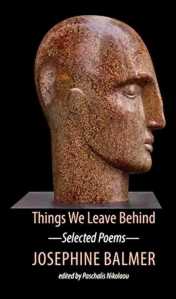
Today sees the publication of Things We Leave Behind: Selected Poems, the culmination of twenty-one years’ work as a published poet (and more than forty as a classical translator). Edited by Paschalis Nikolaou, the volume includes poems from all five of my collections, from Chasing Catullus: poems, translations and transgression  in 2004 (Bloodaxe) to 2022’s Ghost Passage (Shearsman), as well as some new poems from a current work-in-progress. All of these works have explored the relationship of the present to the distant past, the personal to the universal, translation to original.

It is difficult to pick one poem which sums up their trajectory but ‘Star’ from 2017’s Letting Go comes close. One of the final sonnets in a sequence written in response to my mother’s sudden death, it is concerned with reconciliation and acceptance, with the consolation that can be found in a beloved landscape, as well as the echoes that resonate down through the centuries to bring us comfort – ‘the sound of words you can’t say’ – here quoting lines from Sappho fragments 104b & a in lines 10-14, based on my own previous translations. It is accompanied below by one of the images created by Alistair Common for our joint exhibition of poetry and photography at the University of Exeter in November 2024.

Star

So we come full circle to falling dusk.
Above Priest’s Cove, the sky is darkening
through Brisons rocks, evening hesitating
between clouds and sea, cautious, on the cusp.
A shard of moon slips through, blurred with regret,
fresh votive to this place, our penitence
for the lost: parents, old friends and the house
we mourned as if a lover rashly left.

But the day has gone, its turning point passed.
Now the most beautiful of all the stars –
the evening star, shepherd star, Hesperus –
gathers all that light-tinged dawn has scattered;
it guides the fishing boats, herds in sailors,
sends daughters running home to their mothers.

Josephine Balmer

Image © Alistair Common
Poetry & Photography: Reflections of West Cornwall

I have known Cornwall-based photographer Alistair Common for twenty-five years and recently we decided to work together on an exhibition of his photographs and my poems to be held next month (November 2024) at The Forum in the University of Exeter (see full details here).

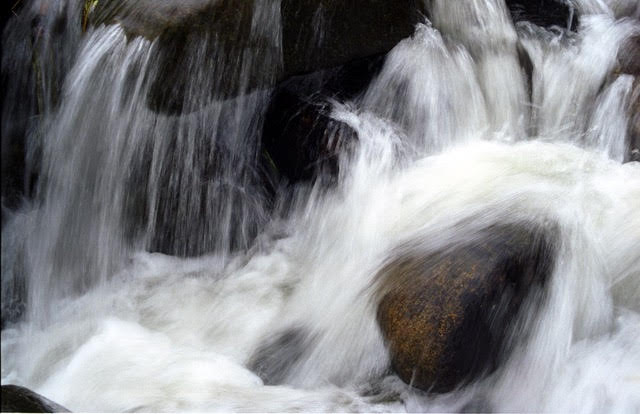
But the idea had been germinating for far longer than that, ever since I saw his luminous print ‘Portheras Stream’ at an exhibition at the Polkadot Gallery in Exeter several years earlier. At once I was reminded of a poem I had written for my 2004 collection Chasing Catullus in a sequence tracing the course of the illness and, tragically, death of my very young niece from cancer.

‘Niobe’ was based on a few lines from a choral passage in Sophocles’ tragedy Antigone, which references the Greek myth of the mother turned to stone as she grieves for the death of her nine children. A literal translation of the original reads (Antigone is singing):
‘I have heard with my own ears how Niobe, daughter of Tantalus, perished in so much suffering on steep Sipylus—how, like clinging ivy, the stone embraced and imprisoned her. And the rains, they say, do not leave her melting form, nor does the snow, and in lamentation tears pour from the brow of the hills over the ridges beneath… ‘(Antigone, ll.823-30)]

For my own poem, I elaborated on this brief snatch. And where Sophocles locates these events in a remote, mountainous region of Lydia in Asia Minor, I relocated the imagery to Britain and the far west of Cornwall, our family home. And I personalised the piece with a new subtitle, a date and time in my sequence’s progression.

Alistair’s photograph echoes not only the geographical description of the piece but also the intensity of its emotions. The streams flow around the rock as if being cut in two by grief. The spray feels icy cold. Yet there is healing in its clear waters. Affirmation.

That said, our intention throughout planning the exhibition was not to offer a literal trade-off between verbal and visual forms but a dialogue, without need for explication, revealing how each can co-exist, each complement the other. We are interested in the exchange of art forms, in the translation and reception between classical and contemporary cultures and landscapes – whether Cornish or ancient Greek – but above all between the image and the written word.

Niobe
(2/8: 7.22 AM)

Like a cloud-burst on a Penwith day
that had to come yet still startles, shocks;
think of granite veined with pale-rose quartz,
a fret of stone where the bracken’s frayed
by aching, flint-pierced, moorland streams;
the bind of ivy, the prick of gorse,
hedged in with comfrey, helleborine;
sob of rain, scar of hail, snow shrinking
to sigh. The sound of words you can’t say.


Josephine Balmer

The Fingers

Last spring I was invited by Dr Elena Theodorakopoulos of the University of Birmingham to visit two of its museums, the Department of Classics’ Archaeology Collection and the Eton Myers Egyptology Collection (on permanent loan from Eton College).

After being shown some of the beautiful treasures of both collections by curators Maeve McHugh, Leire Olabarria and Carolyn Routledge – and being given the rare privilege of holding them myself – I went away to compose a series of poems inspired by their artefacts. These were then performed at a public event, held in the Archaeology Collection on Saturday 18th November as part of the 2023 Being Human Festival of the Arts and Humanities.

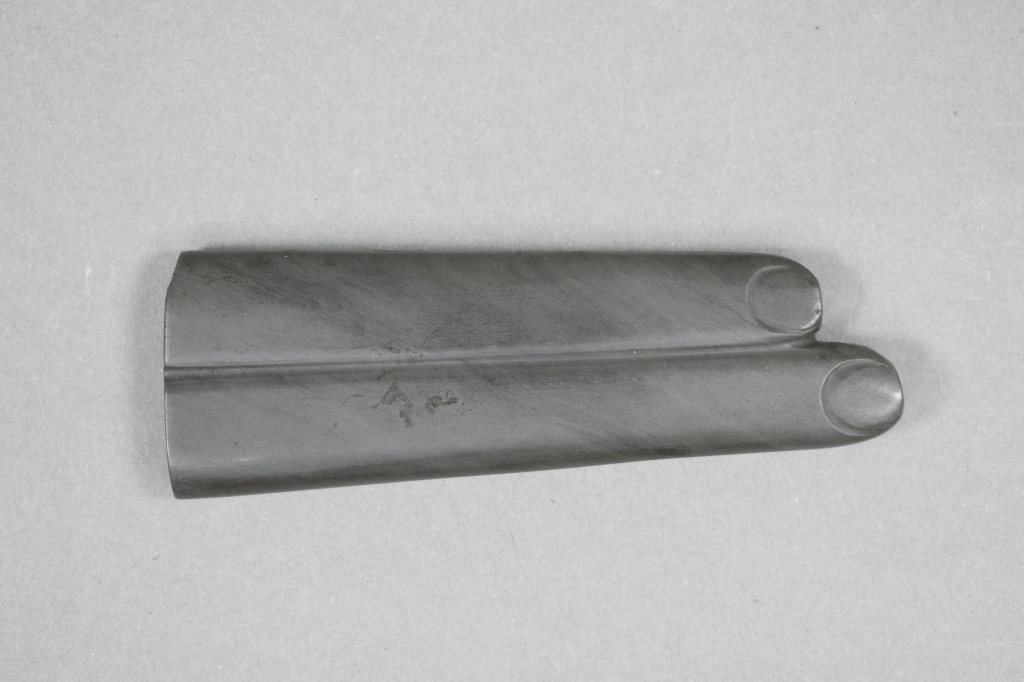
Despite the splendour of so many of the pieces, the following poem was inspired by a much plainer exhibit which had caught my eye in the Eton-Myers collection. It’s a small amulet, made of hard obsidian, in the shape of a pair of fingers. These, as Leire and Carolyn had explained, would be placed on the cut from which the embalmers had removed the deceased’s entrails during the mummification process. It seemed such a tender, caring gesture, and one which led me back to a recent personal life event, the death of my father from vascular dementia:

The Fingers

As if stemming tears or shushing regrets,
blowing kisses for a lover’s scurried exit,
they would lay those ashen, obsidian fingers
on the incision wound. And now my father
was embalmed, shrunken into his best suit,
outsizing the years he’d no longer compute.
Three weeks ago, abruptly, he’d forgotten
how to swallow. Slowly the hunger lessened
as we watched him drain away, diminish:
flesh, skin, sinew, even, at the last, speech.

Somehow he raised two bony fingers at us,
at first in jest, still cursing, still mischievous.
And then a prince on the brink of abdication,
a rogue priest bestowing final benediction.

(photograph: Carolyn Routledge ©Research & Cultural Collections, University of Birmingham and the Provost & Fellows of Eton College)

Thumbs-Up: A Woman Gladiator in Roman London?

Image Copyright: Guildhall Library

In 1996, a 2nd-3rd century CE Roman grave was discovered in Southwark London containing some fascinating grave goods of eight clay lamps, one of which shows a fallen gladiator. Three more depict Anubis, the Egyptian god of the dead in the Isis cult, who accompanied souls on their journey to the underworld and was often associated with gladiators (all are now on display in the Museum of London). So was this the grave of a professional gladiator? Possibly. But there was one further piece of the puzzle. This was the grave of a woman.

Female gladiators are known from imperial Rome and great excitement followed, particularly in the press, about the idea of one being buried in London. Archaeologists, as they are apt, were rather more wary. Some suggested that the woman could have been simply a devotee of the Games (Juvenal’s Satires reveal that many Roman women followed them avidly). Others concluded that the grave goods suggested a more general belief in the afterlife and the possibility of resurrection, represented by gladiatorial conquests and, in particular, their missio or respite after being defeated: the thumbs-up. In my poem from Ghost Passage, inspired by the grave, I wanted to admit to both possibilities. To keep things open, as poetry can do perhaps more easily than scholarship. The eerily atmospheric remains of London’s Roman Amphitheatre, hidden away beneath the Guildhall in the City of London, also provided inspiration.

Thumbs Up
Gladiator grave lamps, Southwark, London, 220 CE

Even as a girl I was besotted, mesmerised.
For my tenth birthday my father sent me
to the Games. He told me we were Isaics,
Syrians, who honoured the boundarie
s

between passing worlds, this and the next.
We did not come, he warned, to watch men die
but to rehearse our own, approaching deaths.
I learnt that we all stare through the cracks


of the Underworld. Gladiators report back.
That day I understood how it feels to breathe
by common lungs; how our fear pulses
through a shared vein, a spider’s thread spun


across from warrior to warrior to spectator.
Time passed. Once, somewhere, I gave birth;
my first kill was on account. The rest
without remorse. Thrust by thrust, lung
e

by lunge, roar by roar, I matched the men
in battle lust. Now my own death is here.
I light its rusted path with lamps for Anubis
keeper of secrets, weigher of souls. I wait


at his trembling threshold to beg for missio
and redemption. Thumbs up. As I hesitate
in that closing light, I hear the hushed slow
hum of blood. And then walk with courage


from arena into gore-sluiced darkness.

Ghost Passage: Poetry as Archaeology

Today is the publication day of my new collection, Ghost Passage, from Shearsman Books. These poems are inspired by writing that stands outside the usual preconceptions of literature: inscriptions, graffitied household objects, and a cache of Roman writing tablets recently excavated at the Bloomberg site in the City of London. From these incomplete and fragmentary remnants of everyday life, I have teased out the stories of those who might have written them, extrapolating outwards to fill the space and silence that surrounds them. To explore history – and poetry – from the ground up.

This is where the ‘objectivity’ of archaeology and the ‘subjectivity’ of poetry overlap. Like poets, archaeologists seek to uncover lost fragments of human existence, the detritus we leave behind, whether physical or emotional. They forge connections between past and present, inevitably and inescapably reading that past in terms of our present. And where archaeology excavates beautiful, lost objects, long-buried in the accumulating silt of history, poetry excavates language, particularly image and metaphor, from the dusty inspiration of time and place. Both meticulously brush away the dirt to restore the colour and vibrancy to long-forgotten or discarded artefacts. Above all, both seek to reconstruct the tattered fragments, to rebuild the fallen cities, to give breath to the silent voices.

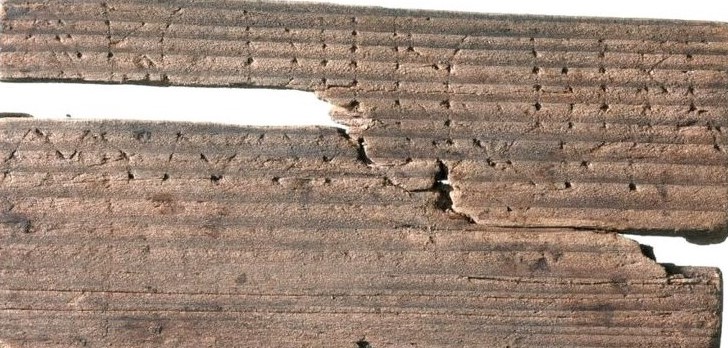
The following sonnet from the collection, “New Roman”, is based on Bloomberg Writing Tablet 79. This is scored simply with a Roman alphabet and apparently used for teaching letters. It probably dates from c.61/2 CE, just after London’s destruction by Boudicca. My inspiration here  was the rebuilding of a city after war, especially as I was working on the poem after watching news reports on children in Syrian refugee camps, desperate to return to school:

New Roman

Walbrook, London 61 CE

ABCDEFGHIKL
MNOPQRST…

In a charred shack we learn our lessons.

Through the smoke I can smell sorrel, ramsons,
blackthorn blossom drifting across like ash
as the shouts of soldiers shatter our hush
and wagons of the dead still roll on past.

We do not want this world, the old language:
destruction, put to fire, revolt, flight, death.
Our task is to etch a new alphabet –
new letters, new tools to rebuild our homes,
gardens for us children, games to play, schools.
We’ll smooth the jagged edge of dialect
and salve its gaping wounds in majuscule.

A-B-C: the scorched march of New Roman
turning blackened wood into cold white stone.

Josephine Balmer

For other poems from the collection on this blog, see here, here and here.

The Earliest London Pub

Some of the most important inhabitants of Roman London – at least for its new citizens – were those involved in the brewing, distribution and selling of alcohol. A recently-discovered writing tablet, excavated during the building of the new Bloomberg Headquarters in the City of London, contains the fragmentary accounts of one Crispus, a brewer or innkeeper (or both), detailing the consumption of rather large amounts of beer (WT.72).

The tablet dates from any time between c. 65-80 CE. For this poem (first published in New Statesman) from my forthcoming collection, Ghost Passage, I chose to situate it towards the end of this period, during the governorship of Agricola, father-in-law of the historian Tacitus. Tacitus recounts how Agricola expanded Roman territory into the far, wild north of Britain, and then on into Scotland or Caledonia – a time when his soldiers would surely have needed a few drinks to see them through…

Account

Supplied to Crispus’s tavern:
Beer,   5 denarii [1000 pints]
           7 denarii [1400 pints]

Night after night we had the thankless task
of keeping the city watered. As soon
as one emptied we’d fill another cask
until our streets brimmed with swaying legions
waiting on their orders (by all reports
our rash new governor, that ambitious
arsewipe Agricola, would now march north).

I didn’t blame them. As a veteran
I knew those roads, the rigid, bone-strewn paths
that level worlds while names, careers, are built.
This was Caledonia: dark, unmapped,
uncrossed, its tarns as deep as hidden guilt,
its forests trembling like a long-planned trap.
Every drop they drained would soon be spilt
.

Josephine Balmer

Keepsake: An Inscribed Stylus from Roman London

In the early 2010s, a tiny writing stylus was discovered at Walbrook in the City of London, during excavations for the Bloomberg European headquarters. Remarkably, this stylus, which dates to c.70 CE, was engraved on all of its four sides with a minuscule inscription.  

photograph © MOLA

Such finds are very rare. Its message was later painstakingly deciphered and transcribed by Dr Roger Tomlin of the University of Oxford, as you can find on a Museum of London Archaeology blog. As Dr Tomlin notes, the stylus appears to be a souvenir, a cheap gift to remind the recipient of its sender, with a message along the lines of our modern ‘I went to Rome and all I got you was this pen’.

 In the autumn of 2019, the stylus was exhibited for the first time as part of  the Oxford Ashmolean museum’s Last Supper in Pompeii exhibition where I was delighted to have an opportunity to see it. While scholarly attention was quite rightly focused on the message of the stylus and its possible recipient, when I began to write about it, I found myself wondering about its sender. Again, any find which illustrates literacy in the empire, particularly in the then new province of Britain, is bound to raise discussion about officials, soldiers or even traders – the male population of the island. But the voice that came to me was that of a woman with her own reasons to feel short-changed…:


Keepsake

From Rome,  a keepsake to bring you pleasure –
a pointed gift so you will always remember;
I wish I could have given you so much more
but the journey is long and funds are short.

I’m sure he threw it in the stream. London,
I’d heard, was in ferment, packed with pleasure:
fine wines, sweet ale, and most of all women,
its frost-edged dusk a lure to warm the bones.

My message, sharpened, in miniature,
would go unread, unmarked. He didn’t know
there was a further present still to come
from that brief, jasmined night he’d forgotten –
those pared hours we shared before he embarked –

but I relived by day; how the moon grazed
the sea at Ostia like a polished blade
as each serrated kiss cut time in half.

A keepsake to bring you pleasure. Ten days
old. Her father in replica. As sharp.

Josephine Balmer
(This poem first appeared in ARTEMISpoetry journal, 24, May 2020)

Destruction Horizon

romanboudicaIn 60 CE, nearly twenty years after the Roman emperor Claudius had annexed Britain, British tribes led by the Iceni Queen Boudica revolted against their Roman conquerors. In his account of the rebellion, the Roman historian Tacitus describes how the British first turned their attention to the city of Camulodunum, modern Colchester, razing it to the ground, before marching on Londinium or London.

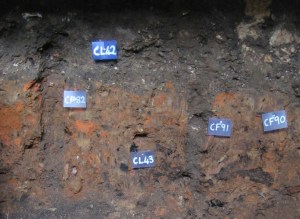
Perhaps surprisingly, in the face of this threat, the then governor of Britain, Suetonius Paulinus, decided to retreat from the city and leave London to its fate; as the Roman historian Tacitus explains, he “abandoned a city to save the province”. With nothing standing in the way of her forces, Boudica’s sack of London was so savage that even now archaeologists refer to her ‘destruction horizon’ a layer of earth containing ash, soot and burnt artefacts denoting that past, catastrophic event.

boudica-town-hall-stain-glass-window-320-458The following poem, first published in the New Statesman earlier this year (18th April) is written in the voice of Suetonius Paulinus. It follows firstly Greek historian Cassius Dio’s description (63) of the portents that preceded Boudica’s attack and then Tacitus’s own account in his Annals (14.33) which pinpoints the human cost of Suetonius’s decision:
 

Destruction Horizon

Walbrook, London, 60 CE

On the streets, priests spoke of omens,
babbling voices in the lock-down Basilica,
laughter rattling out from empty theatres,
a twin city reflected in the rising Thames.

I didn’t waver. We didn’t have the numbers.
I gave the command to march on. Some came.
Most were trapped by age or sex, a strange
allegiance to this border post, a tenderness
for hovels they somehow held as home.
They saw the dust storm spinning nearer,
carrying their own deaths – and the British.
A tally of thousands for that bitch Boudica.

But we left them a marker in memorial,
our destruction horizon: impacted soil,
a trickle of red ash like dried-up blood.
Dig down. Dig deep. It’s soaked in the mud.

                         Josephine Balmer

destruction Horizon (2)

Let Go Fear: Future Virgils

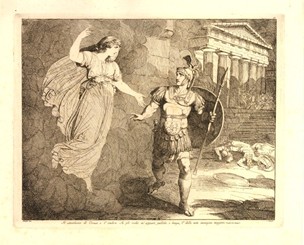
Creusa & AeneasTomorrow marks the eighth anniversary of my mother’s death. As anyone who has suffered a similar loss will know, this time has passed so slowly and at the same time so quickly too. Last year I published a sequence of thirty sonnets, Letting Go, which traced the process of bereavement after a sudden death, from the first days of dazed disbelief to some kind of final acceptance, both of which will clearly be different for everyone. Last month I wrote the Afterword for a vast new study, Virgil and his Translators, edited by the endlessly patient Susanna Braund and Zara Torlone, in which I discussed a few of the sonnets in Letting Go I had written out of passages from Virgil’s Aeneid.

One of these, ‘Let Go’, which comes towards the end of the sequence, is based on a passage from Virgil, Aeneid, 2.768-94. Here, as Aeneas desperately searches Troy for his missing wife Creusa, her ghost appears to him, telling him to move on to Rome without her. The sonnet is based on a real dream I had in a Bed and Breakfast in Norwich after speaking at a seminar at the University of East Anglia – the sort of dislocation, the waking in strange beds that those who travel often for work will recognise – in which my mum did appear to me, suddenly, out of crowds on a street. In ‘Let Go’ I voiced my narrative through Aeneas’s first person account. This was because I was looking to transgress/transcend gender, but also because I wanted Creusa’s ghost to become my mother’s – which, inevitably, then cast me, in turn, as Aeneas. I also liked the device of turning Creusa’s somewhat dark message into a hopeful, warm one as this reminded me so much of the sort of thing my mother would do – the sort of thing she would want to say to me if she could (if not necessarily encouraging me to found a city empire …). As I wrote in my Afterword for Virgil and his Translators it ‘seemed a fitting memorial to my mother’s always unwavering support of my ambitions’:


Let Go 

after Virgil

Those nights I called her name in vain again
and again, filled ruined cities with tears.
I dreamt I reached familiar streets, my fear
fixing tongue to roof of mouth, hair on end;
again she came to me through parted crowds,
smarter than ever in weathershield mac,
blood red lipstick and jaunty, matching hat
like a warrior plume. ‘I can’t stay long now,’
she said, ‘yet am always here. Remember
to hold your hopes close, guard your ambition.
Love. Travel. Most of all, let go anger
or this exile of grief will be too long.’
I tried and tried and tried to embrace her
but, like a thought on waking, she was gone.

Josephine Balmer

See also Letting Go: head versus heart, Mother’s Day and Family Histories
Agenda Letting Go coverVirgil and his translators


Revisiting Sappho

Sappho coverAs a translator, revisiting a text or series of texts you first worked on many years ago is always a fascinating – and daunting – task. This week Bloodaxe Books publish a new, revised edition of my Sappho: Poems and Fragments, which initially appeared with Brilliance Books in 1984, followed in 1992 by its first Bloodaxe edition. The new volume contains translations of several recent discoveries of fragments by the Greek poet, some of which offer rewritings and re-readings of previously known fragmentary poems. Others provide tantalising glimpses of  hitherto unknown fragments.

One of the new fragments in this latter group, fragment 16a (No. 124 in Sappho: Poems and Fragments), derives from a series of papyri acquired by the private Green Collection in Oklahoma City, and later published by Sappho textual scholar Dirk Obbink in 2014.  Its sparse eight lines could represent the opening stanzas of a new poem that followed fragment 16, the Ode to Anactoria, in textual editions. Alternatively, in his latest textual edition of the new fragments, Obbink has argued that this new piece might instead constitute a continuation of fragment 16 itself, a poem many editors had previously thought complete.

Whatever the truth, the new fragment’s opening stanza appears to chime with the theme and concerns of much of Sappho’s love poetry; the nature of desire and the ways in which the lover might find happiness. As Obbink has noted, it also features a typically Sapphic progression from generalised experience (‘No, it is not possible for anyone/to be completely happy…’) to that of the individual, whether or not identified as the poet herself.

kairosThe fragment’s second stanza is far more incomplete but nevertheless contains some startling images. In line 6 of the fragment the words ep’akras, or literally ‘on the edges’, could refer to a Greek expression for ‘on tiptoes’. The following line appears to have an equally arresting reference to chion, in Homer used of fallen snow. This could evoke the figure of Kairos or ‘Opportunity’, the concept of acting at the correct time or seizing the day, which in Greek art and mythology was often portrayed as a young man running on tiptoes. But ep’akras was also used of being ‘on the edge’ of a changing season, particularly spring, which chimed with the later mention of (perhaps melting) snow. In addition, the verb which Obbink reads as ebas, or ‘you went’ echoes the eba (‘she went’) used of Helen’s desertion of Paris in fragment 16. And so I added in some conjectures here to include the image of a lover leaving like fleeting snow in the spring:


No, it is not possible for anyone
to be completely happy. And so we pray
that we might have our own small share. I myself
bear witness to this…                                                                       

[Seize the fleeting moment as it] comes to pass…  
… you went away on the brink [of spring]….
….[vanished like the melting] snow. But she…
…many things….
untitled