The Paths of Survival

– the poetry of history –

Tag: The Paths of Survival

The Librarians’ Power

book as kindlingThis week is National Libraries Week, a celebration of the wonderful work libraries – and their librarians – do over and over again, day in, day out, offering us all free access to books, especially in these times of increasingly severe local authority budget cuts.

From classical times onwards, this work has always been highly-valued and history resonates with the grief of the loss of such institutions. The story of the destruction of the first great library at Alexandria is told over and over again, if often by sources hostile to the alleged perpetrators. We learn of the accidental fire of Julius Caesar in 48 BCE, the supposed malicious damage of rioting Christian mobs in 391 CE or even the alleged burning of the last few remaining volumes in the city’s bathhouse furnaces by its Arab conqueror Amr ibn al-Asi in 642  (the last is almost certainly apocryphal). Whatever the cause, whatever the agenda of its chroniclers, this sense of horror at the loss of the written word reverberates through the centuries.

But such devastating, wholesale destruction is not confined to the classical or early medieval era. In 2003, during the Gulf War, the famed and ancient National Library of Baghdad was set on fire by a stray incendiary bomb, illustrating how the destruction of literary culture is, sadly, still relevant to us in the twenty-first century. And how we should never take our libraries for granted.

Apart from the National Library’s own important collections, such Arabic centers of learning have always been important in preserving classical literature over the centuries, particularly scientific works. And within such works of science, small snatches of more literary texts were often quoted – and so also saved. And again, in 2003, its determined and dedicated librarians battled to recover its precious, ancient books in the aftermath of the bomb.

The following poem from The Paths of Survival was inspired by an article by Zainab Bahrani with photographs by Roger LeMoyne in the US journal Document (Spring/Summer 2013), and gives voices to those amazing Baghdad Librarians:

The Librarians’ Power

(The National Library, Baghdad, 2003)

We carried what we could to safety.

They seemed like something living:
fungus on an oak, the pleated folds
of open mushroom cup, organisms
that were once books, manuscripts,
now debris of ‘precision’ incendiary.

To conserve them we needed ice
not fire. In a ruined kitchen cellar
we found a freezer but no power;
we canvassed, coaxed, cajoled
until locals offered the sacrifice
of their one precious generator.

We were asked why we struggled
to save books while all around us
so many of our citizens were lost.
We could only say that, if not flesh,
here were dividing cells, bare blocks
of collective memory. Conscience.

The vast record of all our knowledge
and of our faith: an ancient Quran,
the House of Wisdom we had built;
the learning we alone had salvaged
and then protected for the Greeks –
Ptolemy’s Almagest, science, medicine.

Those lost worlds were retrieved
in the flash of forceps, lifting piece
on tiny piece, word on broken word.
Our own enduring, unshakeable belief
that in each newly-deciphered letter
a poem waited to be recovered.

Josephine Balmer

The Pagan’s Tip

A family in fourth century CE Oxyrhynchus decides it is time to dispose of their library of classical, pre-Christian texts…


romanshelf libraryIn my last post, a fictional Alexandrian scribe copied lines of Aeschylus’ Myrmidons for a cash-rich family from Oxyrhynchus. Here, in another poem from my forthcoming collection, The Paths of Survival, we move on in time another two centuries to find his customer’s descendants deciding that, in a Christian empire, it is time to make a gesture.

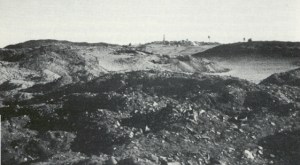
oxysite rubbish mounds at oxyrhynchusIn particular, they feel, it would be politic to dump the works in their treasured family library on the town rubbish tip – including the copies of Aeschylus’ tragedies our cantankerous scribe had worked so hard to produce for them. Here, of course, the papyri will later be excavated in tattered strips by late nineteenth and early twentieth century archaeologists, beginning the painstaking process of piecing what little might remain of those texts back together…:
 

The Pagan’s Tip
(Oxyrhynchus, Upper Egypt, 370)

Today we sacrificed our last bull –
not easy with just the five of us.
Walking back with Kallas, my cousin,
we both agreed it was time to stop.
Now, we said, we are all Christians.

That night I gathered up the volumes
my family had prized over the years:
philosophy, poetry, the great dramas
of Aeschylus, epigrams of Palladas –
works our ancestor had bought home
in triumph from a trip to Alexandria.

Those pages hold our history like maps.
If I run my fingers over the covers,
their gold letters and tooled leather,
I can trace the twisted paths of our past.
This is who we were and what we are:
grammarians, clerks, petty bureaucrats.

On the shelf I replaced each space
with Paul’s Epistles, all the Gospels.
Ours I took out beyond the walls
among the flies and rotting waste,
left them there for the rats to soil
like any piece of discarded refuse.

Do the same, if you want my advice.

Josephine Balmer

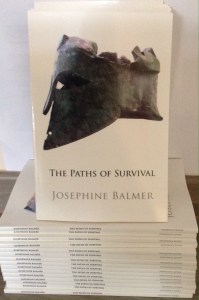
The Paths of Survival will be published by Shearsman on April 7th.

shearsman-cover

Final Sentence

img_0296

It is always a hugely exciting time when the hard work of several years is distilled into a written text. For this celebratory post on the publication of The Paths of Survival, as in the book, I’d like to begin at the end with a tattered piece of papyrus in the collection of an Oxford University library. Oxyrhynchus Papyrus 2256 contains nearly 90 scraps of papyrus. Of these, number 55 constitutes four, barely legible half-lines of  Aeschylus’ lost play Myrmidons. Part of its text could read ‘kata skoton’ or ‘into darkness’ – a snatch, maybe, of the lover’s lament Achilles murmurs over Patroclus’ dead body. Here is the homoerotic passion which later rendered Myrmidons such a difficult and controversial work, probably sealing its demise (and a link, too, to the copy my fictional scribe is making, centuries earlier, in ‘Blot’ and then its disposal on the rubbish piles of Oxyrynchus in ‘The Pagan’s Tip’) .

POxy 2256 frag 55 (2)

It is, of course, heart-breaking that, along with a handful or so of similar fragments, this is all we have left of Aeschylus’ tragic masterpiece. It is also a warning that our own cultures might be far more fragile than we think. Yet in each small miracle of survival, there is always something to celebrate. For somehow, by judgement or by error but mostly through happenstance, something of the written text, of literary culture, however damaged, however minuscule, has managed to escape all those centuries of ignorance, war, persecution and destruction. Like the lined faces of  the old, each crease and blemish tells a unique story of experience and endurance. Proof that words can – and do – thrive where all else is lost.


Final Sentence

(Sackler Library, Oxford, Present Day)

Still I am drawn to it like breath to glass.
That ache of absence, wrench of nothingness,
stark lacunae we all must someday face.

I imagine its letters freshly seared;
a scribe sighing over ebbing taper,
impatient to earn night’s coming pleasures
as light seeped out of Alexandria.

But in these hushed corners of Oxford
Library afternoons, milky with dust,
the air is weighted down by accruing loss

and this displaced scrap of frayed papyrus
whose mutilated words can just be read,
one final, half-sentence: Into darkness…
Prophetic. Patient. Hanging by a thread.

Josephine Balmer

The Paths of Survival is published by Shearsman.  You can order a copy  here or here.

shearsman-cover

The Scribe’s Blot

A grumpy scribe finds solace in the Greek play he is copying – and two words in particular that will survive when the rest have been lost…


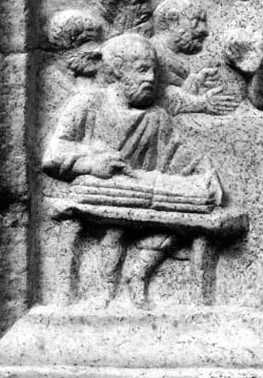
scribes anticaScribes are the unsung heroes of the survival of any classical work; without them there would be no written papyrus texts and codices, and hence no fragments of drama or poetry. We know that scribes often worked from ‘scriptoriums’, maybe booths or workshops in city marketplaces where customers might request a work to be copied for their private libraries.
But what did the scribes themselves feel about the work they copied – and sometimes saved -for posterity? In the following poem, from my new collection The Paths of Survival, a grumpy and rather troubled scribe from second century CE Alexandria  feels he is wasting his time as he copies Aeschylus’ Myrmidons – a difficult and by now increasingly obscure text – for a socially mobile client. He knows that they will almost certainly never read the play but instead be looking to impress their friends and neighbours with their highbrow taste (while the knowledge that his customer comes from Oxyrhynchus alerts us to the fact that, far in the future, the scribe’s hard-copied text will turn up in tatters, excavated from the rubbish tips of the ancient city). And yet, as he proceeds with his work, he finds echoes of his own sorrow in Aeschylus’ tragic play – and two words that will survive when the rest have been lost…


Blot
(Alexandria, 150)

It barely matters if I blot or blotch –
these days no one asks for Aeschylus.

As light fades I head for the streets –
a cheap tavern or the house of whores –
to scrub off this stain of guilt and remorse,
flaws that cling like yesterday’s rotten fish.
On mornings after, I retake my seat,
propping up each eyelid with stylus tip,
making errors I can later edit… 

And then, today, a buyer for my script:
some pompous provincial bureaucrat
up from Oxyrhynchus with hard cash,
back-handers he’s been itching to shift.
He claims he wants High Art, Myrmidons
(though he couldn’t tell drama from dog shit –

all he cares is how it looks on the shelf).

For him I etch these words of love and grief.
I think of my wife, dead after a few weeks;
there’d been a baby, some complication,
the pockmarked physician couldn’t tell which.
I came back one night and she was gone.

Into darkness… The skin I, too, must live in.
Mistakes uncorrected, holding the blame.

The only words left now to mask the pain.
                                                                   

   Josephine Balmer

(A longer version of this poem first appeared in Arion (24.2: Fall, 2016))


shearsman-cover