
Ghost Passage: Poetry as Archaeology

Today is the publication day of my new collection, Ghost Passage, from Shearsman Books. These poems are inspired by writing that stands outside the usual preconceptions of literature: inscriptions, graffitied household objects, and a cache of Roman writing tablets recently excavated at the Bloomberg site in the City of London. From these incomplete and fragmentary remnants of everyday life, I have teased out the stories of those who might have written them, extrapolating outwards to fill the space and silence that surrounds them. To explore history – and poetry – from the ground up.
This is where the ‘objectivity’ of archaeology and the ‘subjectivity’ of poetry overlap. Like poets, archaeologists seek to uncover lost fragments of human existence, the detritus we leave behind, whether physical or emotional. They forge connections between past and present, inevitably and inescapably reading that past in terms of our present. And where archaeology excavates beautiful, lost objects, long-buried in the accumulating silt of history, poetry excavates language, particularly image and metaphor, from the dusty inspiration of time and place. Both meticulously brush away the dirt to restore the colour and vibrancy to long-forgotten or discarded artefacts. Above all, both seek to reconstruct the tattered fragments, to rebuild the fallen cities, to give breath to the silent voices.
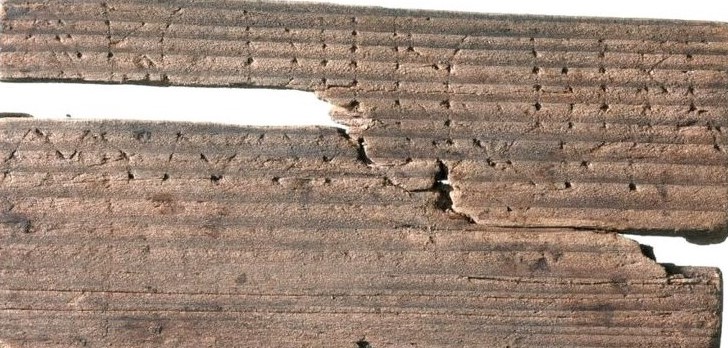
The following sonnet from the collection, “New Roman”, is based on Bloomberg Writing Tablet 79. This is scored simply with a Roman alphabet and apparently used for teaching letters. It probably dates from c.61/2 CE, just after London’s destruction by Boudicca. My inspiration here was the rebuilding of a city after war, especially as I was working on the poem after watching news reports on children in Syrian refugee camps, desperate to return to school:
New Roman
Walbrook, London 61 CE
ABCDEFGHIKL
MNOPQRST…
In a charred shack we learn our lessons.
Through the smoke I can smell sorrel, ramsons,
blackthorn blossom drifting across like ash
as the shouts of soldiers shatter our hush
and wagons of the dead still roll on past.
We do not want this world, the old language:
destruction, put to fire, revolt, flight, death.
Our task is to etch a new alphabet –
new letters, new tools to rebuild our homes,
gardens for us children, games to play, schools.
We’ll smooth the jagged edge of dialect
and salve its gaping wounds in majuscule.
A-B-C: the scorched march of New Roman
turning blackened wood into cold white stone.
Josephine Balmer
For other poems from the collection on this blog, see here, here and here.

 In 60 CE, nearly twenty years after the Roman emperor Claudius had annexed Britain, British tribes led by the Iceni Queen Boudica revolted against their Roman conquerors. In his account of the rebellion, the Roman historian Tacitus describes how the British first turned their attention to the city of Camulodunum, modern Colchester, razing it to the ground, before marching on Londinium or London.
 The following poem, first published in the New Statesman earlier this year (18th April) is written in the voice of Suetonius Paulinus. It follows firstly Greek historian Cassius Dio’s description (63) of the portents that preceded Boudica’s attack and then Tacitus’s own account in his Annals (14.33) which pinpoints the human cost of Suetonius’s decision: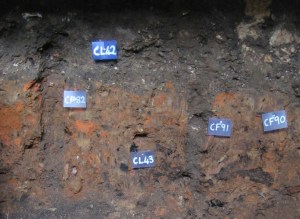
 Nigel Farage might have been concerned about Romanians moving in next door but, as an inscription from Roman Colchester reveals, eastern European immigrants have been part of the British landscape since the first century A.D.
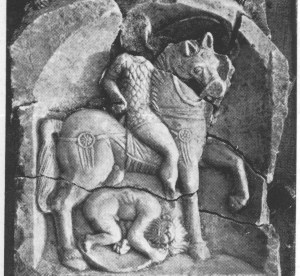 In his funerary sculpture, Longinus is depicted on his horse with his cavalry chain mail tunic and small round shield, brandishing his spear while a defeated British tribesman cowers beneath his horse’s hooves. The damaged text of the tomb’s inscription translates literally as follows: Longinus, Sdapeze s[on of] Matygus, duplicarius, of the 1st cavalry squadron of Thracians from the district of Sardica, aged 40, with 15 years service, lies here. His heirs erected this under his will.
 The Paths of Survival