
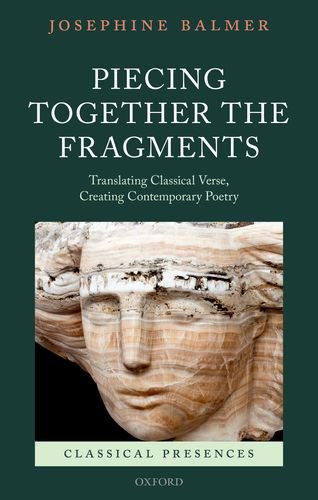
My new book on translation and poetry, Piecing Together the Fragments: Translating Classical Verse, Creating Contemporary Poetry, will be published by Oxford University Press in September. Here is the first short taster, an extract from the section on my 1996 volume Classical Women Poets (published by Bloodaxe Books). This explores how, in conjunction with classical scholarship, translation can reanimate and rehabilitate lost fragments by forgotten ancient poets, here by Hedyle, a woman poet from Athens:
A Snatch of Sea Air: Hedyle’s ‘Scylla’
Hedyle, the only extant woman poet from Athens, was harder to track down, despite the city’s far more mainstream literary tradition. As Nancy Sorkin Rabinowitz has noted of classical Athens: ‘there were times and places more hospitable to women writers.’ Similarly, when collecting poets for her 1983 anthology, ‘Women Poets of the World’, Joanna Bankier discovered that women writers seem to flourish in ‘decentralised cultures’ but vanished under ‘a strong centralised power’ where poetry became a prestigious activity. Thought to date from the third century BC, a snatch of Hedyle’s mythological poem, ‘Scylla’, had originally been quoted by Athenaeus (7.297A) around AD 200.
But so obscure was the piece that Jane Synder’s indispensible ‘The Woman and the Lyre’ made only passing reference to it, although Diane Rayor included a literal translation in her 1991 anthology, ‘Sappho’s Lyre’, in which one Glaucus presents love gifts of ‘cockleshells from the Erythraian reef’ and ‘still unfledged halcyon chicks’ to a sea-nymph, Scylla. Through Rayor’s excellent referencing, I tracked down an edited text in ‘Supplementum Hellenisticum’. This points to a fascinating re-imagining of the myth of Homer’s six-headed sea-monster, Scylla, here seen in her youth as a beautiful girl, loved unrequitedly by the merman, Glaucus.
Hedyle’s approach appears to contrast starkly with Ovid’s version centuries later in his ‘Metamorphoses’, where Glaucus turns to the Homeric sorceress Circe for help but, falling in love with him herself, Circe jealously transforms her rival Scylla into a monster (13.904ff,14.66ff). But where Ovid’s Glaucus is overcome by sexual passion, wooing Scylla only with an account of his own troubles, Hedyle’s protagonist is tender and hesitant, furthering his suit with lover’s gifts. Meanwhile, in an engaging modern reimagining by Vicki Feaver for Michael Hofmann and James Lasdun’s influential 1994 project, ‘After Ovid: New Metamorphoses’, Scylla is a hapless bystander to Circe, who articulates her own revenge: ‘Because he wouldn’t enter me/I made her unenterable – Scylla/the nymph who fled from the god…/I wanted.’
If such texts were hard to come by, textual commentaries were practically non-existent, apart from Diane Rayor’s brief but helpful notes to her translation, in which she commented on the suitability of Glaucus’s sea-themed gifts. But, as I began to work on the piece, I found further artifice in Hedyle’s list; not just the sea imagery of corals and shells – also associated with Aphrodite, the goddess of love – but the kingfisher chicks, given by lovers in antiquity as symbols of undying love, after the myth of Alcyone who threw herself into the sea when her husband Ceyx was drowned (in the Scylla myth the rejected Glaucus also drowns himself). Kingfishers had other associations, too, namely the Greek-derived phrase ‘halcyon days’, the fourteen winter days when the birds built their nests in the calm before the storm. I incorporated this reading in to my version, stretching Hedyle’s sparse five and a half lines into two stanzas.
In the Greek, it is unclear who is the subject of the fragment’s opening lines. In my version, I transformed these into a first-person speech by Glaucus in order to foreground his lover’s emotion. This could then be contrasted to and distanced from the poet’s authorial voice which ends the extract. To me, the piece seemed a strange and beautiful fragment, concentrated, like the work of many of the women poets, around absence and loss. As I noted in my introductory comments in ‘Classical Women Poets’, in a few, brief tantalising lines, ‘Hedyle weaves a complex and ironic association of faith and betrayal, hope and disappointment, love and grief’:
Scylla
‘I brought you shells, Scylla, from clear coral reefs
and kingfisher chicks still learning how to fly –
those halcyon days to come. All these I gave
without faith, without hope.’
At Glaucus’s grief
Sirens wept, his fellow dwellers of the deep;
and they swam in sorrow from their rocky shore
by simmering Etna….
You can find more details on Piecing Together the Fragments on the OUP website here. Or pre order it on Amazon here. There is also a small article about it in the current OUP Classical Studies catalogue which you can find here.
Next time: an exploration of the ways in which classical works and their translation can provide a voice through which a poet might say the unsayable.

 As I explored previously in my 2004 collection, Chasing Catullus (and my subsequent study Piecing Together the Fragments), ancient, classical texts have long provided us with a means to articulate present grief. Five years ago this month, in November 2010, my mother died very suddenly of a heart attack. It took a long time to be able to write about this and even then, as with Chasing Catullus, I found I could do so only through the resonant echo of classical voices.
 Just published in the latest edition of Agenda, Family Histories, the following sonnet is based around lines from Aeneid 2 (735-55), in which Aeneas, escaping from a burning Troy with his family, realises to his horror that his wife Creusa is no longer with them.
 The Paths of Survival