
The Monastery’s Treasure
A tiny yet passionate fragment of Aeschylus’s lost drama Myrmidons is discovered in a surprising place…
 In 1959, a previously unknown edition of the ninth century Lexicon of Photius was discovered at the remote Greek Orthodox Monastery of Zavorda in Macedonia, northern Greece (you can find an account of this by Roger Pearse here). This edition included some pages that were not available in other known editions of the Lexicon, all based on the Codex Galeanus, a 12th century parchment ms. of 149 leaves. Although the Zavorda manuscript is later than the Codex Galeanus, dating from the 13th-14th century, it is the only complete surviving manuscript of the text, containing additional pages and entries absent from other editions, including words beginning with alpha (άβ to άγ).
I was taken with the fact that these new extra pages include the Greek word abdeluktos which, as previously discussed, Photius tells us means ‘without stain’ or ‘absolved of blame’. Unlike other, later sources, he also notes that it originates in a line from Aeschylus’s lost play Myrmidons, almost certainly as the grieving hero Achilles embraces the corpse of his slain lover Patroclus, exclaiming that such an act is not an abomination ‘because I love him’.
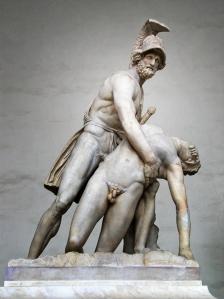 Photius’ Lexicon is not alone in surviving in the library of a Greek monastery; many works were taken to such safe places following political and religious upheavals in the east, for example after the sack of Constantinople by western soldiers during the so-called Fourth Crusade in 1204, as explored in an earlier post here. As well as marvelling at the tiny miracles and random happenstance at the heart of such textual survivals, I also wondered how the monks would have felt had they known that, for centuries, they had been custodians of evidence of such a passionate, later forbidden love.
The following poem, ‘Trespass’, from my collection, The Paths of Survival, explores that conundrum through the voice of an imaginary monk, forming a companion piece to Photius’s own voice in the poem ‘Gloss’.
Trespass
(Monastery of Zavorda, Macedonia, 1959)
From the crag we watched as he drew
near, creeping closer like a contagion.
‘My son, we have been expecting you,’
our unsmiling abbot said in welcome.
From the cadence of his voice we knew
he was not talking of days or decades
but the dry passage of our centuries.
For weeks our guest rifled the libraries,
their rare treasures piled around him –
like a child’s toys or stored-up treats.
Now our abbot did not eat or sleep.
We saw the apprehension in his face
as if some half-recalled, splintered dream
had returned, long dreaded, to haunt him,
a fear he could barely form or elucidate.
Our guest found all he had come to seek:
a tattered codex wrapped round in rags
like some precious shard of brittle glass.
He put on his hat and coat, his work done,
a few more words for his literary canon:
Abdeluktos philo. Absolved because I loved him…
Anathema. The taint of unconstrained sin –
a snatch of Aeschylus’s foul Myrmidons.
In its shadow we had held sacred homily,
called our brethren to vespers, benediction.
Now it was unleashed again, this heresy
we had guarded here without knowing
for so long. Unspeakable acts. Trespass.
We waited as he faded, a blur in the dark,
disappearing back into fold of river pass.
Josephine Balmer

.


 The Paths of Survival