The Paths of Survival

– the poetry of history –

Category: Uncategorized

The Monastery’s Treasure

A tiny yet passionate fragment of Aeschylus’s lost drama Myrmidons is discovered in a surprising place…


zavordaIn 1959, a previously unknown edition of the ninth century Lexicon of Photius  was discovered at the remote Greek Orthodox Monastery of Zavorda in Macedonia, northern Greece (you can find an account of this by Roger Pearse here). This edition included some pages that were not available in other known editions of the Lexicon, all based on the Codex Galeanus, a 12th century parchment ms. of 149 leaves. Although the Zavorda manuscript is later than the Codex Galeanus, dating from the 13th-14th century, it is the only complete surviving manuscript of the text, containing additional pages and entries absent from other editions, including words beginning with alpha (άβ to άγ).

I was taken with the fact that these new extra pages include the Greek word abdeluktos which, as previously discussed,  Photius tells us means ‘without stain’ or ‘absolved of blame’. Unlike other, later sources, he also notes that it originates in a line from Aeschylus’s lost play Myrmidons, almost certainly as the grieving hero Achilles embraces the corpse of his slain lover Patroclus, exclaiming that such an act is not an abomination ‘because I love him’.
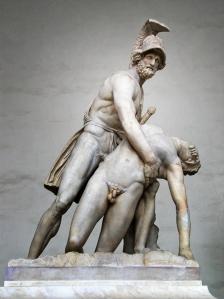
b15f7f0c9bf1b615d0536e1586c85870Photius’ Lexicon is not alone in surviving in the library of a Greek monastery; many works were taken to such safe places following political and religious upheavals in the east, for example after the sack of Constantinople by western soldiers during the so-called Fourth Crusade in 1204, as explored in an earlier post here. As well as marvelling at the tiny miracles and random happenstance at the heart of such textual survivals, I also wondered how the monks would have felt had they known that, for centuries, they had been custodians of evidence of such a passionate, later forbidden love.


The following poem, ‘Trespass’, from my collection, The Paths of Survival, explores that conundrum through the voice of an imaginary monk, forming a companion piece to Photius’s own voice in the poem ‘Gloss’.


Trespass

(Monastery of Zavorda, Macedonia, 1959)

From the crag we watched as he drew
near, creeping closer like a contagion.
‘My son, we have been expecting you,’
our unsmiling abbot said in welcome.
From the cadence of his voice we knew
he was not talking of days or decades
but the dry passage of our centuries.
For weeks our guest rifled the libraries,
their rare treasures piled around him –
like a child’s toys or stored-up treats.

Now our abbot did not eat or sleep.
We saw the apprehension in his face
as if some half-recalled, splintered dream
had returned, long dreaded, to haunt him,
a fear he could barely form or elucidate.
Our guest found all he had come to seek:
a tattered codex wrapped round in rags
like some precious shard of brittle glass.
He put on his hat and coat, his work done,
a few more words for his literary canon:

Abdeluktos philo. Absolved because I loved him
Anathema. The taint of unconstrained sin –
a snatch of Aeschylus’s foul Myrmidons.
In its shadow we had held sacred homily,
called our brethren to vespers, benediction.
Now it was unleashed again, this heresy
we had guarded here without knowing
for so long. Unspeakable acts. Trespass.

We waited as he faded, a blur in the dark,
disappearing back into fold of river pass.

                                                  Josephine Balmer

shearsman-cover


.

The Patriarch’s Gloss

A rare Greek word – and a homoerotic line – from a lost tragedy,  preserved in a Lexicon compiled by an uncompromising Byzantine Pope, provides a link between atrocity, justification and language.


photiusPhotius I (later St Photius the Great) was a secular clerk who was appointed Patriarch (or Pope) of Byzantium in 858 following a time of often bloody religious schism in the city between the iconclasts, who wanted to destroy images of God as idolatrous, and the orthodox church, which viewed such depictions as holy relics. In 868 Photius was temporarily unseated but returned to the patriarchal throne in 877 when he continued his persecution of the city’s Jews.


phot-lexiconAt the same time, Photius was revered as a cultured man whose classical scholarship was second to none. His Lexicon, probably written in his youth and revised later, contains many rare Greek words and their usage, including abdeluktos, an adjective meaning something like ‘absolved of blame’. Photius tells us the word originates in a line from Aeschylus’s lost play Myrmidons, probably from a  scene in which the grieving hero Achilles caresses the body of his dead lover Patroclus. In recording it, this uncompromising Church father preserved perhaps one of the most controversial scraps of  Aeschylus’s tragedy for the future. The following sonnet from my new collection  The Paths of Survival (Shearsman, April 2017)  first appeared in New Statesman, and explores the link between atrocity, justification and language:


Gloss
(Photius I, Byzantium, 858/877)


I worked my way up by my wits, from clerk
to city Patriarch. I corrected
each schism, effaced the iconoclasts
until our gilded streets turned black. And red.

In broken churches we counted the deaths.
I remembered a reed-slim boy of nine
or ten, the taste of his salt lips on mine –
weed-choked detritus dragged from Golden Horn.

Now terms were defined in my Lexicon.
I started with alpha: Abdeluktos.
Above blame. Any heretics tortured,
maimed. Absent of guilt. All Jews slaughtered.
[ᴂbdɛlʊktos]. A sword hissing through bone.
Absolved. Assaults washed clean by each fresh gloss.

Josephine Balmer

shearsman-cover


The Clerk’s Crusade

800px-PriseDeConstantinople1204PalmaLeJeuneEight hundred and twelve years ago to the day, on April 8th 1204, during the Fourth Crusade, the siege of Constantinople began. What distinguishes this Crusade is that, rather than a conflict between Christian and Muslim Arabs, it pitted Christian against Christian, as mutinous Crusader forces from the western or Latin church turned their attention on the eastern city of Constantinople, drawn, in part, by the booty to be looted from its famous riches.

With the help of a Venetian army, the Latins set up camp across the Golden Horn in Galata but, after an initial assault, were driven back by bad weather. On 12th April they launched another attack, this time breaching the city walls by burrowing holes just big enough for single soldiers to crawl through. For three days the Latins looted the city, destroying its Library and melting down its golden treasures to cart away. Thousands were killed or raped, churches were stripped of their holy treasures.

In the following poem, from my collection, The Paths of Survival, my clerk- narrator is fictional but the incidents he describes are based on contemporary eye-witness accounts, including the rather ignominious departure of the city’s aristocracy. And yet they, like my anonymous clerk, were probably responsible for saving many great works of literature from the city, taking them away with them to Nicaea,  where the Byzantines established new empire states, or the safe hiding places of monasteries in Greece.


 The Clerk’s Crusade
                     (Constantinople, 12th April 1204)

The first thing we noticed was mortar
crumbling, sand trickling from a stone.
Even rats, the Captain shrugged, get restless
under siege, gnawed by our same hunger.
The guards returned to their next throw
of dice. And I slunk back to Library desk.

We could not know, did not even guess
our city was already falling, already ash.

Next day we all saw it, the slab shift
and slowly tilt. We stood transfixed
as a single block of wall rolled back
and chasm opened where it collapsed;
ten withered fingers gripped the edge,
then Crusader helmet on Crusader head.
Our captain gave orders. On cue we fled.

That night Byzantium was melted down.
Everything they could move, they took.
All else was toppled into steaming pots,
vast statues shrunk to stumps of bronze,
for each piece of tessera, another life lost. 

Myself, I looted what they overlooked.

As Latin bishops stripped our churches
of jewels, I stuffed my splattered jerkin
with a few foxed and battered books:
Photius’s Lexicon, Lucian, Athenaeus.
Here was no Holy War but Christian
against Christian, West against East.
Better the Saracens. They had belief.

I ran back through the streets, slipping
on spilt blood, fresh excrement, filth.
Far off, a woman sobbed, out of reach.
I squeezed out through the breach,
a conqueror in reverse. For in Nicaea
or the monasteries of Thessalonica,
we would soon found another empire.

Our nobles crept away like thieves
as the Latins jeered, waving inkpots,
quills – the weapons not of warriors
but meek scholars, they hissed.

                                               Let them mock.

Where they had cruelty, we had culture.
Where they had greed, we had Greek.

                                                      Josephine Balmer


Mother’s Day


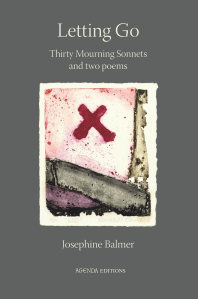
KONICA MINOLTA DIGITAL CAMERAToday is Mothering Sunday in the UK. It would also have been my mother’s 82nd birthday. It’s a difficult day for all who have lost a beloved parent – or child – but the following poem, from my forthcoming sonnet sequence, Letting Go (Agenda Editions, July 2017), sees the beginning of a reconciliation with grief, offering in its place a celebration of mothers and daughters through the generations. Its starting point is a passage from Homer’s Odyssey Book 9 (lines21-8) in which Odysseus, who has been washed ashore on Phaeacia, longingly tells the Phaeacians of his own home island of Ithaca from which he has now been absent for 20 years.

2015-04-27 15.42.17Odysseus’s description seemed to chime with the view from a seat on the coastal foot path near my mother’s childhood house in Marazion, west Cornwall. As a girl, my mother often sat on the seat with her own mother or her aunt on the way to church at Perranuthnoe on Sunday evenings. Later I sat with her there many times, looking out over St Michael’s Mount and its Bay, chatting about family or the wildflowers we saw in the verges. I sat there again last April with my husband Paul just as the blossom was coming out along the hedgerows:
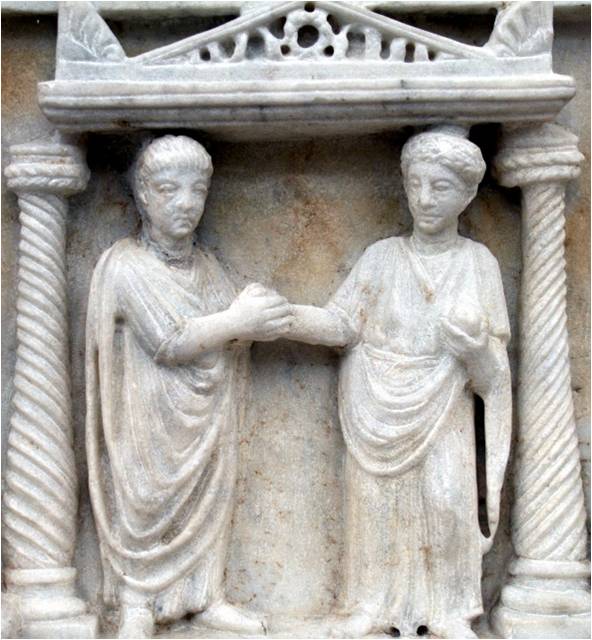
Seat 

Even from the bench, the bay is undimmed;
beyond hazy blackthorn the Mount quivers
as its pine trees tilt, reeled back by the wind –
the marker that tells us we’re really here
at the far point, lying low, facing west.
Below, rocks snag across a land on loan
from the turning tide, shrunk into darkness.
Nothing soothes the soul like the sight of home:
this one rears daughters fierce as fighting men.
Here’s where you rested with your own mother
watching swifts dip, dissect the setting sun,
by paths picked out in selfheal and clover.
Blood and bone pack the sacred ground beneath:
your place. My longed-for Ithaca. Our seat.

Josephine Balmer

letting-go-first-pic


Palladas: The Other Half Speaks Out I

Palladas picThese versions of Palladas were commissioned for ‘Palladas: The New Papyrus’, an international conference held at  University College, London on 4th-5th September 2014. This centred on the discovery of a new codex containing around 60 new epigrams (possibly!) by the fourth (or maybe fifth?) century AD Alexandrian poet. These have recently been published with an exhaustive commentary by Professor Kevin Wilkinson of  the University of Toronto.

After reading the poems, I decided that my versions could only answer the ill-tempered misogyny for which Palladas is famed. Hence my title, The Other Half Speaks Out. I also decided to work both on some of the older epigrams, long collected in the Greek Anthology, as well as some of the new, mostly very fragmentary poems from the papyrus.

My first version was of Palladas 9.773, a famous epigram, often taken to refer to the triumph of Christianity over paganism. Here the poet imagines a statue of the Greek love god Eros, melted down into a frying pan, presumably now superfluous to requirements in a predominantly Christian world. A literal translation of this is as follows:
A bronze-smith, melting down Eros, fashioned a frying pan – not unreasonably, since that too burns.
But as I began to work on the poem, it occurred to me that the juxtaposition of love, frying pans – and burning – might have extra resonances for women readers. This was my new version:

From Fat to Frying Pan
First he burned with words, kisses;
Promising a life together, a few kids.
And then it was: where’s my breakfast?
Or, I don’t like my eggs done like this.
Time, like an alchemist or blacksmith,
Has hammered out love, our own Eros,
Shrunk it down, from fat to frying pan.
Never mind: now it is my turn to burn
The best bacon. To waste his good eggs.

My next new version was after 11.287, one of Palladas’ most difficult poems for a woman translator (and/or reader) to approach. In fact, when I Googled it for a text, the first heading that came up was ‘Patriarchal Male Fantasy’. The literal translation shows why:
Cursed with an ugly wife, when he lights the evening candles, he still sees only gloom
In my version, the woman, that wife, responds to her particular charmer of a husband:

Holding a Candle
When I hear his step on the stair,
See the flicker of the evening light
On his yellow teeth or thinning hair
As he peers into that gloomy night,
I turn my face to the peeling wall.
I dream of the lips of my first love
While he snores on or snuffles off.
 He couldn’t even hold a candle.

My final version of an ‘old’ poem, was 11.306. Literally translated, this reads:
Even if, after Alexandria, you leave for Antioch, and, after Syria, you then arrive in Italy, no powerful man will marry you; for ever in hope, you will hop from city to city.
This put me in mind straightaway of another, much more modern Alexandrian poet, C.P. Cavafy, and, in particular, his famous poem, ‘The City’. I therefore decided to filter my response to Palladas  through the prism of Cavafy, using the latter modern poet’s trademark direct reported speech form.  But I also added a coda, a response from the woman quoted:

 All the Same
(i)
You might say: ‘Time to look for another spot,
Kiss goodbye to Alexandria, head for Antioch
Or Italy – to find a man who is rich and powerful
(Or both).’ But just as you are unmarriageable
In this one city, so you will always be alone
As you hop from bed to bed, time zone to time zone.
(ii)
Yes, I’m the woman who’s had her fair ration –
From A to A, I have run the full gamut of men:
The losers, the liars, the cheats without shame.
Here’s a flash: world over, they’re all the same.

With thanks to the conference organisers – Professor Edith Hall of Kings College, London and Professor Chris Carey and Dr Maria Kanellou of University College, London – for their generous hospitality.

Next time: versions of Palladas’ new poems


The First Eastern European Immigrant

As Article 50 is triggered, let us remember just how long European immigrants have been in Britain…


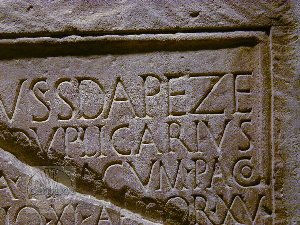
Colchester inscriptionNigel Farage might have been concerned about Romanians moving in next door but, as an inscription from Roman Colchester reveals, eastern European immigrants have been part of the British landscape since the first century A.D.
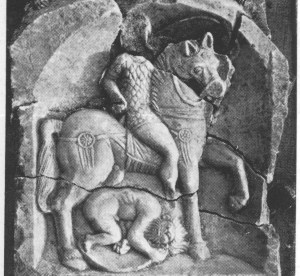
In 1928 workmen building new garages on the site of the main Roman cemetery in the town uncovered the fragmented funeral stele of Longinus ‘Sdapezematygus’, an auxiliaryman from Sardica, the modern Bulgarian city of Sofia. Remarkably the figure’s missing face – possibly hacked off during the revolt of Boudicca in 60/1 – was then discovered over seventy years later in 1996 during a dig by the Colchester Archaeology Group. One of the earliest Roman tombs in Britain, Longinus must have died between the invasion of Claudius in A.D. 43, who established Colchester (Camulodonum) as his initial legionary capital, but before the legion withdrew in 49.

Longinus (3)In his funerary sculpture, Longinus is depicted on his horse with his cavalry chain mail tunic and small round shield, brandishing his spear while a defeated British tribesman cowers beneath his horse’s hooves. The damaged text of the tomb’s inscription translates literally as follows: Longinus, Sdapeze s[on of] Matygus, duplicarius, of the 1st cavalry squadron of Thracians from the district of Sardica, aged 40, with 15 years service, lies here. His heirs erected this under his will.
Here we learn that Longinus, presumably his adopted Latin name, was a dulpicarius, a ‘double pay’ junior officer, such as a standard bearer or centurion’s deputy; by birth he is from Thrace, a region which covered northern Greece, Turkey and a large part of Bulgaria.

In the following poem, Longinus’s brief inscription has become a fourteen-line sonnet which incorporates other source material about early Roman Britain such as the prized British Agassian hunting dogs described by many ancient sources, as well as the island’s reputation for good quality wool – and oysters. Perhaps unsurprisingly, many classical writers also had much to say about the new province’s disappointing weather.

A Thracian Auxiliaryman at Colchester

They never managed to pronounce my name;
as I’m tall, I was always just ‘Longinus’
though my father was Sdapezematygus,
a Thracian, from Sofia. Can’t complain:
I was on double time. The days were dank
but the oysters were good. I bought a cloak
plus a new hunting bitch, Agassia,
with squat little legs, sharp teeth and soft paws
(the wife and kids back home would have loved her).
Fifteen years I served with the cavalry
across the east – Syria, Scythia –
at forty it ends here. Remember me:
I was part of the advance, one of the first.
Your ancestor. My bones still feed this earth.

The Articulation of Grief III: How Personal Should Personal Poetry Be?

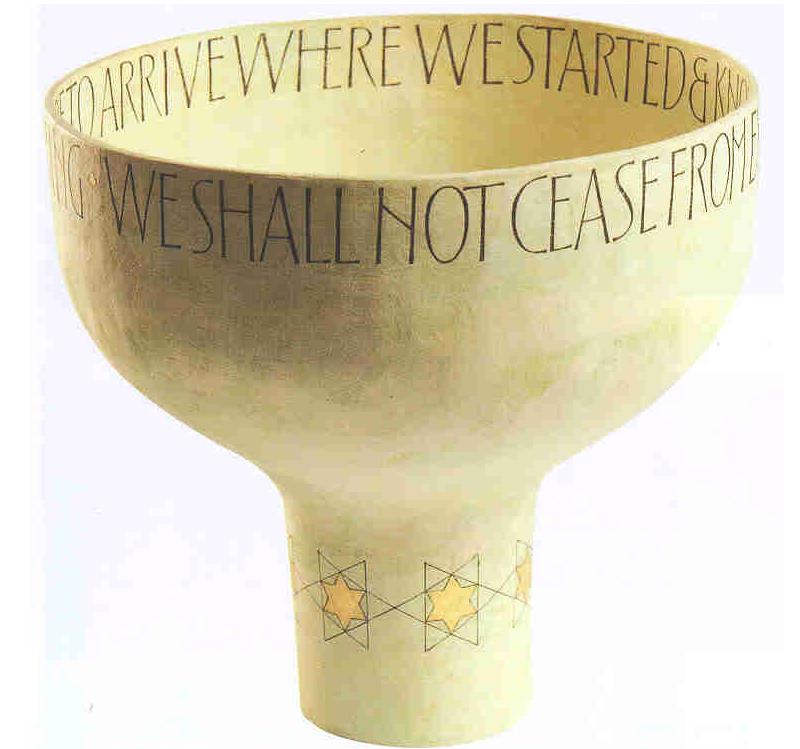
dolbyBowlIn this third extract from Piecing Together the Fragments, published last week by OUP, I will be looking at the thorny issue of just how private and personal poetry should be – and how, through translation, this dilemma can be addressed, if not resolved. As in my previous extract, this passage comes from my discussion of my 2004 volume, Chasing Catullus, and examines questions raised by a series of poems written after the death of my niece from cancer.

Throughout these poetic appropriations [in Chasing Catullus],  I felt increasingly uneasy, not just at the exposure of such deeply personal experiences but at the unavoidable issue of the validity of turning such private trauma into literature.

Considering these issues, both personal and professional, I came across a passage from the Republic (398a) in which Plato explains that, while poets would be welcomed if they visited his Utopian city, they would not be allowed to live there: ‘If a man, it seems, who was capable by his cunning of assuming every kind of shape and imitating all things, should arrive in our city, looking to exhibit his work, we should worship him as a holy and wondrous being, but would tell him that we have no man of such a kind in our city, nor is it lawful for any such one to be there. And, having anointed him with myrrh and crowned him with garlands, we would send him away to another city’.

This extract provided a foundation text for a new poem, ‘Cancel the Invite’, elaborating on Plato’s original, stretching it, transgressing it, transforming prose in to poetry. In this last transformation, I was influenced by James Harpur’s 1996 poem ‘The Flight of the Sparrow’, which I had long admired, and which preformed similar metamorphoses on Bede’s image of the brevity of life as a sparrow flying through a mead hall on a dark  night. I also overlaid my text with echoes of T.S. Eliot’s ‘Little Gidding’ from Four Quartets, which I had been reading at the time of my niece’s funeral, and which formed another layer of intertextuality, another palimpsest. For instance, lines 21 ff of Eliot’s poem are deliberately recalled in its opening lines. In this way, ‘Cancel the Invite’ provided a dialogue with its preceding poems, questioning whether such personal material should be used as poetic subject-matter, and articulating my own conflict about the issue:

 If you came, if you came this way to our city,
 taking the old road, the salt road, up from the harbour,
 and it’s early days, mid-morning, late September,
 sky an upturned limpet’s shell, flesh-scooped, chalk blue –
  or later, maybe, at dusk in depths of winter,
the sky a pebble dropping to a shore-line pool…
And if you came, if you should slip through our gates
while our guards are down, dealing out their final hands –
Proteus back from exile to walk our boarded streets,
beggar, broken king, virgin trembling on the brink
(for we know you can change face – and heart – at will);
 and if you reached, by chance, our marbled market halls
to find some unclaimed spot, set out your same old wares
we’ve all seen, we’ve all heard too many times before
(and besides, could buy cheaper in any local stores)
then we’d welcome you as a stranger, as a guest,
wash your dusty feet, throw fresh garlands round your neck,
commend your art, revere your turncoat trickster’s skill,
and then, because poets are forbidden here by law –
for we need doctors, surgeons, men to find the cure –
we’d show you, so politely, to the waiting door.

Poems such as these not only translate but interact with their source text, re-enacting as well as voicing otherwise unapproachable or uncomfortable emotions such as grief or guilt. Here, translation becomes a part of the transformed poem’s metaphoric landscape or perhaps, as Charles Tomlinson expresses it, quoting Georges Braque’s Cahiers D’Art: ‘“no longer concerned with metaphor but metamorphoses”.’ As Tomlinson continues, such metamorphosis transforms its object ‘into a less predictable, a more variously multi-faceted image’. I also wanted to see how far the line between translation and poetry would stretch, to use translation in new and different ways, to take it as far as it would possibly go as a creative art form in itself, until translation and original poem became indivisible from the other. As I noted in my preface to the volume, my aim in the collection had been: ‘not only to blur the distinction between original and translation, but to make it unimportant, until the reader – or even the writer – cannot distinguish between the two.’

51BWqT1tOsLYou can find more details and a sample chapter of Piecing Together the Fragments on the OUP website here. Or order it on Amazon here. There is also a small article about it in the current OUP Classical Studies catalogue which you can find here.

For more information on Hazel Dolby’s wonderful calligraphy and artefacts  click here  

Classical Versioning and the Articulation of Grief

DP114272In this second taster extract from ‘Piecing Together the Fragments’, I examine the writing of my first collection, Chasing Catullus, published by Bloodaxe Books in 2004, a work which employed classical texts and versioning as a means of approaching family bereavement and grief. It is also a memorial to my niece Rachel as this week sees the seventeenth anniversary of her death. She would have been twenty-five next month.

                 Speaking Through A Text: Ovid’s Many-Headed Hydra
At the same time as exploring new ways of approaching translation and versioning, I was also grasping for a way to deal with personal grief. Just after I finished Classical Women Poets and had began to work on Catullus: Poems of Love and Hate, my sister’s then six-year-old daughter was diagnosed with aggressive stomach cancer, a period which ended tragically with my niece’s death in August 1996. I had recorded these experiences in a notebook as a means of exorcism but had put these writings aside, too painful even for myself to read. But gradually through the dark fog of bereavement, I began to write again in the only way I found that I could: through the prism of classical literature – and its translation. Similarly, it is interesting that classical scholar Thomas Van Nortwick has recorded how his study of Greek literature, particularly Homer, helped him to come to terms with the early death of a beloved nephew. As he asks himself: ‘What can Greek literature teach me about the role of gifts in the life of a spirit?’

These new poems form a diary sequence, comprising Chasing Catullus’s second, central section, which follows, both directly or obliquely, the course of my niece’s illness, its most private or difficult events articulated through the voices of classical myth and literary reference, the vocabulary through which I could begin to the unsayable. As Sullivan notes of Pound’s various literary ventriloquisms: ‘[he] realized that what he wanted to express could only be expressed in that particular way.’ In addition, Elizabeth Dodd has argued that American women poets such as H.D., Elizabeth Bishop and Louise Glück, have worked in a form of ‘personal classicism’, a means to become a woman poet in a male, literary world but at the same time to avoid the confessional tone of Anne Sexton or Sylvia Plath…

…The sequence also made use of embedded quotes from classical texts – the quotes Stephen Harrison has termed ‘appropriated’ – in order to articulate a dialogue between source text and original poem. For example, the poem, ‘Cutting the Hydra’, a proverbial expression in classical Greek for attempting an impossible task, addresses a surgeon’s initially confident but, tragically, ultimately unsuccessful attempt to remove my niece’s tumour. Here, the poem’s first stanza is based on Ovid’s account of Hercules’s slaying of the monstrous many-headed serpent, the Hydra (Metamorphoses 9. 67-78). As Hercules’ heroic confidence is deflated, its second stanza returns to my own narrative voice, referencing the later myth of Hercules, killed by his wife Deianira, who gave him a shirt dipped in the Hydra’s poisonous blood:

Cutting the Hydra

He said: “It’s child’s play, the cradle work of Junior days,
labours I’ve performed since I was little more than boy;
so if you think we can be beaten by some snake in grass,
remember, of this seething coil, you are one small part:
true, it breeds on its own death; hack away a head, any
of its many hundred necks, and two improved grow back,
fed on evil, foul branches of the serpent’s tree
but I’m its master – and what I master I destroy.”

Afterwards he couldn’t even look us in the face.
I saw him going home to his own Deianira,
tucking into cutlets, mash, one more gin with bitters,
white coat deflated on its peg, buff suit skinned and shed.

As we have seen, for Pound, such adopted selves were masks or personae, a means of speaking through another text. And in these poems, too, as in many others in the sequence, appropriating these different, classical selves allowed me to communicate the horror of the situation without directly narrating it, providing ‘the profound place to hide’ that Charles Rowan Beye has seen in the field; a slippage of self-construction and self-image, affording a means to be of myself and yet out of the self. As I noted in a 2006 paper for the ‘Self and Identity in Translation’ conference at the University of East Anglia, I needed a form that would allow me to practise deception, if not self-deception, a self-protective mechanism which could shield me from the horror of the experience described. All in all, the reality was too painful, too shocking, and ultimately too private, to be portrayed any other way except through the shifting filter of classical literature, weeding out what was or wasn’t acceptable, what might or might not be palatable, not just for the writer but for the reader too.
                                                                                                                                      Josephine Balmer

You can find more details on Piecing Together the Fragments on the OUP website here. Or pre order it on Amazon here. T51BWqT1tOsLhere is also a small article about it in the current OUP Classical Studies catalogue which you can find here.

Next time: a discussion of the issues surrounding the use of personal experience in art – and how speaking through classical texts might help us to resolve them.