The Paths of Survival

– the poetry of history –

Category: Uncategorized

Things We Leave Behind: Selected Poems
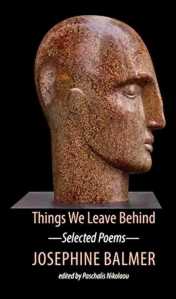
Today sees the publication of Things We Leave Behind: Selected Poems, the culmination of twenty-one years’ work as a published poet (and more than forty as a classical translator). Edited by Paschalis Nikolaou, the volume includes poems from all five of my collections, from Chasing Catullus: poems, translations and transgression  in 2004 (Bloodaxe) to 2022’s Ghost Passage (Shearsman), as well as some new poems from a current work-in-progress. All of these works have explored the relationship of the present to the distant past, the personal to the universal, translation to original.

It is difficult to pick one poem which sums up their trajectory but ‘Star’ from 2017’s Letting Go comes close. One of the final sonnets in a sequence written in response to my mother’s sudden death, it is concerned with reconciliation and acceptance, with the consolation that can be found in a beloved landscape, as well as the echoes that resonate down through the centuries to bring us comfort – ‘the sound of words you can’t say’ – here quoting lines from Sappho fragments 104b & a in lines 10-14, based on my own previous translations. It is accompanied below by one of the images created by Alistair Common for our joint exhibition of poetry and photography at the University of Exeter in November 2024.

Star

So we come full circle to falling dusk.
Above Priest’s Cove, the sky is darkening
through Brisons rocks, evening hesitating
between clouds and sea, cautious, on the cusp.
A shard of moon slips through, blurred with regret,
fresh votive to this place, our penitence
for the lost: parents, old friends and the house
we mourned as if a lover rashly left.

But the day has gone, its turning point passed.
Now the most beautiful of all the stars –
the evening star, shepherd star, Hesperus –
gathers all that light-tinged dawn has scattered;
it guides the fishing boats, herds in sailors,
sends daughters running home to their mothers.

Josephine Balmer

Image © Alistair Common
Poetry & Photography: Reflections of West Cornwall

I have known Cornwall-based photographer Alistair Common for twenty-five years and recently we decided to work together on an exhibition of his photographs and my poems to be held next month (November 2024) at The Forum in the University of Exeter (see full details here).

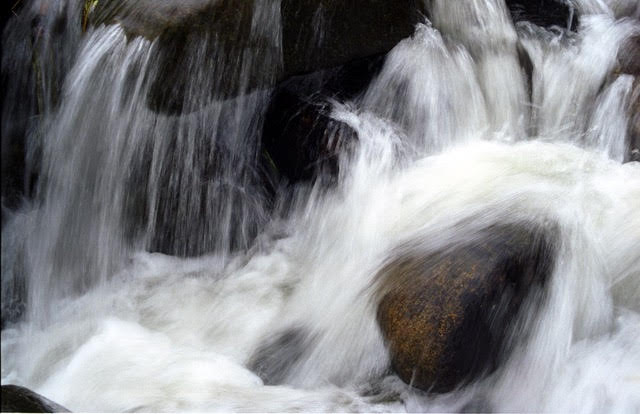
But the idea had been germinating for far longer than that, ever since I saw his luminous print ‘Portheras Stream’ at an exhibition at the Polkadot Gallery in Exeter several years earlier. At once I was reminded of a poem I had written for my 2004 collection Chasing Catullus in a sequence tracing the course of the illness and, tragically, death of my very young niece from cancer.

‘Niobe’ was based on a few lines from a choral passage in Sophocles’ tragedy Antigone, which references the Greek myth of the mother turned to stone as she grieves for the death of her nine children. A literal translation of the original reads (Antigone is singing):
‘I have heard with my own ears how Niobe, daughter of Tantalus, perished in so much suffering on steep Sipylus—how, like clinging ivy, the stone embraced and imprisoned her. And the rains, they say, do not leave her melting form, nor does the snow, and in lamentation tears pour from the brow of the hills over the ridges beneath… ‘(Antigone, ll.823-30)]

For my own poem, I elaborated on this brief snatch. And where Sophocles locates these events in a remote, mountainous region of Lydia in Asia Minor, I relocated the imagery to Britain and the far west of Cornwall, our family home. And I personalised the piece with a new subtitle, a date and time in my sequence’s progression.

Alistair’s photograph echoes not only the geographical description of the piece but also the intensity of its emotions. The streams flow around the rock as if being cut in two by grief. The spray feels icy cold. Yet there is healing in its clear waters. Affirmation.

That said, our intention throughout planning the exhibition was not to offer a literal trade-off between verbal and visual forms but a dialogue, without need for explication, revealing how each can co-exist, each complement the other. We are interested in the exchange of art forms, in the translation and reception between classical and contemporary cultures and landscapes – whether Cornish or ancient Greek – but above all between the image and the written word.

Niobe
(2/8: 7.22 AM)

Like a cloud-burst on a Penwith day
that had to come yet still startles, shocks;
think of granite veined with pale-rose quartz,
a fret of stone where the bracken’s frayed
by aching, flint-pierced, moorland streams;
the bind of ivy, the prick of gorse,
hedged in with comfrey, helleborine;
sob of rain, scar of hail, snow shrinking
to sigh. The sound of words you can’t say.


Josephine Balmer

The Fingers

Last spring I was invited by Dr Elena Theodorakopoulos of the University of Birmingham to visit two of its museums, the Department of Classics’ Archaeology Collection and the Eton Myers Egyptology Collection (on permanent loan from Eton College).

After being shown some of the beautiful treasures of both collections by curators Maeve McHugh, Leire Olabarria and Carolyn Routledge – and being given the rare privilege of holding them myself – I went away to compose a series of poems inspired by their artefacts. These were then performed at a public event, held in the Archaeology Collection on Saturday 18th November as part of the 2023 Being Human Festival of the Arts and Humanities.

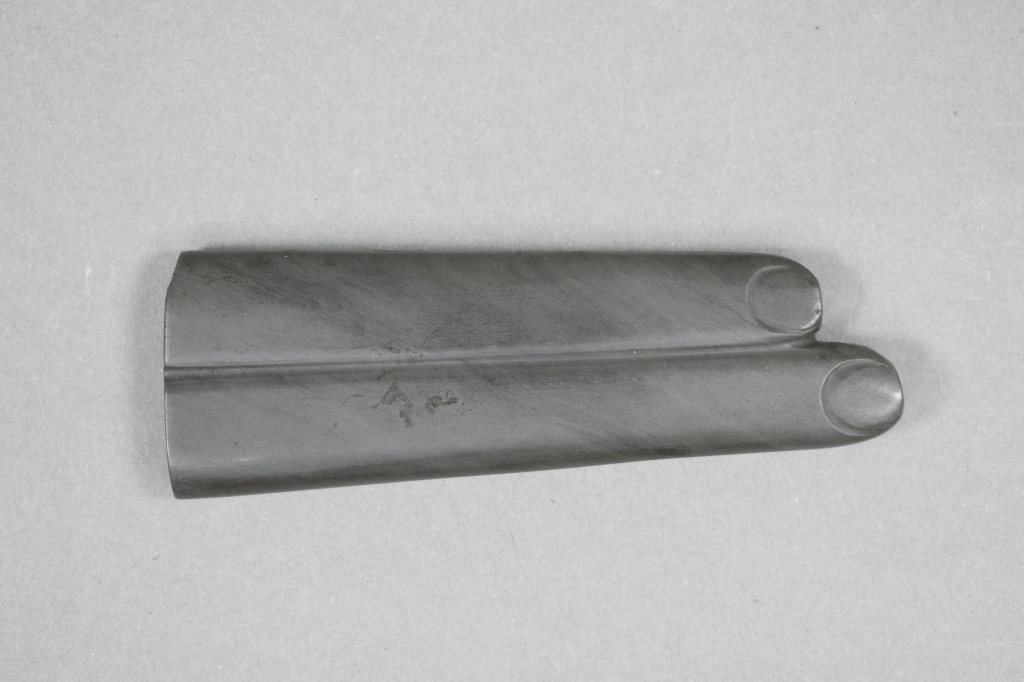
Despite the splendour of so many of the pieces, the following poem was inspired by a much plainer exhibit which had caught my eye in the Eton-Myers collection. It’s a small amulet, made of hard obsidian, in the shape of a pair of fingers. These, as Leire and Carolyn had explained, would be placed on the cut from which the embalmers had removed the deceased’s entrails during the mummification process. It seemed such a tender, caring gesture, and one which led me back to a recent personal life event, the death of my father from vascular dementia:

The Fingers

As if stemming tears or shushing regrets,
blowing kisses for a lover’s scurried exit,
they would lay those ashen, obsidian fingers
on the incision wound. And now my father
was embalmed, shrunken into his best suit,
outsizing the years he’d no longer compute.
Three weeks ago, abruptly, he’d forgotten
how to swallow. Slowly the hunger lessened
as we watched him drain away, diminish:
flesh, skin, sinew, even, at the last, speech.

Somehow he raised two bony fingers at us,
at first in jest, still cursing, still mischievous.
And then a prince on the brink of abdication,
a rogue priest bestowing final benediction.

(photograph: Carolyn Routledge ©Research & Cultural Collections, University of Birmingham and the Provost & Fellows of Eton College)

Thumbs-Up: A Woman Gladiator in Roman London?

Image Copyright: Guildhall Library

In 1996, a 2nd-3rd century CE Roman grave was discovered in Southwark London containing some fascinating grave goods of eight clay lamps, one of which shows a fallen gladiator. Three more depict Anubis, the Egyptian god of the dead in the Isis cult, who accompanied souls on their journey to the underworld and was often associated with gladiators (all are now on display in the Museum of London). So was this the grave of a professional gladiator? Possibly. But there was one further piece of the puzzle. This was the grave of a woman.

Female gladiators are known from imperial Rome and great excitement followed, particularly in the press, about the idea of one being buried in London. Archaeologists, as they are apt, were rather more wary. Some suggested that the woman could have been simply a devotee of the Games (Juvenal’s Satires reveal that many Roman women followed them avidly). Others concluded that the grave goods suggested a more general belief in the afterlife and the possibility of resurrection, represented by gladiatorial conquests and, in particular, their missio or respite after being defeated: the thumbs-up. In my poem from Ghost Passage, inspired by the grave, I wanted to admit to both possibilities. To keep things open, as poetry can do perhaps more easily than scholarship. The eerily atmospheric remains of London’s Roman Amphitheatre, hidden away beneath the Guildhall in the City of London, also provided inspiration.

Thumbs Up
Gladiator grave lamps, Southwark, London, 220 CE

Even as a girl I was besotted, mesmerised.
For my tenth birthday my father sent me
to the Games. He told me we were Isaics,
Syrians, who honoured the boundarie
s

between passing worlds, this and the next.
We did not come, he warned, to watch men die
but to rehearse our own, approaching deaths.
I learnt that we all stare through the cracks


of the Underworld. Gladiators report back.
That day I understood how it feels to breathe
by common lungs; how our fear pulses
through a shared vein, a spider’s thread spun


across from warrior to warrior to spectator.
Time passed. Once, somewhere, I gave birth;
my first kill was on account. The rest
without remorse. Thrust by thrust, lung
e

by lunge, roar by roar, I matched the men
in battle lust. Now my own death is here.
I light its rusted path with lamps for Anubis
keeper of secrets, weigher of souls. I wait


at his trembling threshold to beg for missio
and redemption. Thumbs up. As I hesitate
in that closing light, I hear the hushed slow
hum of blood. And then walk with courage


from arena into gore-sluiced darkness.

The Earliest London Pub

Some of the most important inhabitants of Roman London – at least for its new citizens – were those involved in the brewing, distribution and selling of alcohol. A recently-discovered writing tablet, excavated during the building of the new Bloomberg Headquarters in the City of London, contains the fragmentary accounts of one Crispus, a brewer or innkeeper (or both), detailing the consumption of rather large amounts of beer (WT.72).

The tablet dates from any time between c. 65-80 CE. For this poem (first published in New Statesman) from my forthcoming collection, Ghost Passage, I chose to situate it towards the end of this period, during the governorship of Agricola, father-in-law of the historian Tacitus. Tacitus recounts how Agricola expanded Roman territory into the far, wild north of Britain, and then on into Scotland or Caledonia – a time when his soldiers would surely have needed a few drinks to see them through…

Account

Supplied to Crispus’s tavern:
Beer,   5 denarii [1000 pints]
           7 denarii [1400 pints]

Night after night we had the thankless task
of keeping the city watered. As soon
as one emptied we’d fill another cask
until our streets brimmed with swaying legions
waiting on their orders (by all reports
our rash new governor, that ambitious
arsewipe Agricola, would now march north).

I didn’t blame them. As a veteran
I knew those roads, the rigid, bone-strewn paths
that level worlds while names, careers, are built.
This was Caledonia: dark, unmapped,
uncrossed, its tarns as deep as hidden guilt,
its forests trembling like a long-planned trap.
Every drop they drained would soon be spilt
.

Josephine Balmer

Keepsake: An Inscribed Stylus from Roman London

In the early 2010s, a tiny writing stylus was discovered at Walbrook in the City of London, during excavations for the Bloomberg European headquarters. Remarkably, this stylus, which dates to c.70 CE, was engraved on all of its four sides with a minuscule inscription.  

photograph © MOLA

Such finds are very rare. Its message was later painstakingly deciphered and transcribed by Dr Roger Tomlin of the University of Oxford, as you can find on a Museum of London Archaeology blog. As Dr Tomlin notes, the stylus appears to be a souvenir, a cheap gift to remind the recipient of its sender, with a message along the lines of our modern ‘I went to Rome and all I got you was this pen’.

 In the autumn of 2019, the stylus was exhibited for the first time as part of  the Oxford Ashmolean museum’s Last Supper in Pompeii exhibition where I was delighted to have an opportunity to see it. While scholarly attention was quite rightly focused on the message of the stylus and its possible recipient, when I began to write about it, I found myself wondering about its sender. Again, any find which illustrates literacy in the empire, particularly in the then new province of Britain, is bound to raise discussion about officials, soldiers or even traders – the male population of the island. But the voice that came to me was that of a woman with her own reasons to feel short-changed…:


Keepsake

From Rome,  a keepsake to bring you pleasure –
a pointed gift so you will always remember;
I wish I could have given you so much more
but the journey is long and funds are short.

I’m sure he threw it in the stream. London,
I’d heard, was in ferment, packed with pleasure:
fine wines, sweet ale, and most of all women,
its frost-edged dusk a lure to warm the bones.

My message, sharpened, in miniature,
would go unread, unmarked. He didn’t know
there was a further present still to come
from that brief, jasmined night he’d forgotten –
those pared hours we shared before he embarked –

but I relived by day; how the moon grazed
the sea at Ostia like a polished blade
as each serrated kiss cut time in half.

A keepsake to bring you pleasure. Ten days
old. Her father in replica. As sharp.

Josephine Balmer
(This poem first appeared in ARTEMISpoetry journal, 24, May 2020)

Revisiting Sappho

Sappho coverAs a translator, revisiting a text or series of texts you first worked on many years ago is always a fascinating – and daunting – task. This week Bloodaxe Books publish a new, revised edition of my Sappho: Poems and Fragments, which initially appeared with Brilliance Books in 1984, followed in 1992 by its first Bloodaxe edition. The new volume contains translations of several recent discoveries of fragments by the Greek poet, some of which offer rewritings and re-readings of previously known fragmentary poems. Others provide tantalising glimpses of  hitherto unknown fragments.

One of the new fragments in this latter group, fragment 16a (No. 124 in Sappho: Poems and Fragments), derives from a series of papyri acquired by the private Green Collection in Oklahoma City, and later published by Sappho textual scholar Dirk Obbink in 2014.  Its sparse eight lines could represent the opening stanzas of a new poem that followed fragment 16, the Ode to Anactoria, in textual editions. Alternatively, in his latest textual edition of the new fragments, Obbink has argued that this new piece might instead constitute a continuation of fragment 16 itself, a poem many editors had previously thought complete.

Whatever the truth, the new fragment’s opening stanza appears to chime with the theme and concerns of much of Sappho’s love poetry; the nature of desire and the ways in which the lover might find happiness. As Obbink has noted, it also features a typically Sapphic progression from generalised experience (‘No, it is not possible for anyone/to be completely happy…’) to that of the individual, whether or not identified as the poet herself.

kairosThe fragment’s second stanza is far more incomplete but nevertheless contains some startling images. In line 6 of the fragment the words ep’akras, or literally ‘on the edges’, could refer to a Greek expression for ‘on tiptoes’. The following line appears to have an equally arresting reference to chion, in Homer used of fallen snow. This could evoke the figure of Kairos or ‘Opportunity’, the concept of acting at the correct time or seizing the day, which in Greek art and mythology was often portrayed as a young man running on tiptoes. But ep’akras was also used of being ‘on the edge’ of a changing season, particularly spring, which chimed with the later mention of (perhaps melting) snow. In addition, the verb which Obbink reads as ebas, or ‘you went’ echoes the eba (‘she went’) used of Helen’s desertion of Paris in fragment 16. And so I added in some conjectures here to include the image of a lover leaving like fleeting snow in the spring:
 

No, it is not possible for anyone
to be completely happy. And so we pray
that we might have our own small share. I myself
bear witness to this…                                                                       

[Seize the fleeting moment as it] comes to pass…  
… you went away on the brink [of spring]….
….[vanished like the melting] snow. But she…
…many things….
untitled


The Librarians’ Power

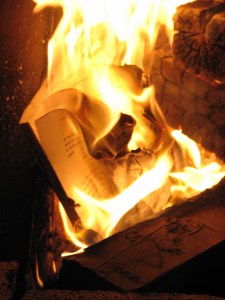
book as kindlingThis week is National Libraries Week, a celebration of the wonderful work libraries – and their librarians – do over and over again, day in, day out, offering us all free access to books, especially in these times of increasingly severe local authority budget cuts.
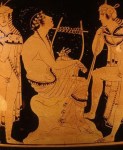
From classical times onwards, this work has always been highly-valued and history resonates with the grief of the loss of such institutions. The story of the destruction of the first great library at Alexandria is told over and over again, if often by sources hostile to the alleged perpetrators. We learn of the accidental fire of Julius Caesar in 48 BCE, the supposed malicious damage of rioting Christian mobs in 391 CE or even the alleged burning of the last few remaining volumes in the city’s bathhouse furnaces by its Arab conqueror Amr ibn al-Asi in 642  (the last is almost certainly apocryphal). Whatever the cause, whatever the agenda of its chroniclers, this sense of horror at the loss of the written word reverberates through the centuries.

But such devastating, wholesale destruction is not confined to the classical or early medieval era. In 2003, during the Gulf War, the famed and ancient National Library of Baghdad was set on fire by a stray incendiary bomb, illustrating how the destruction of literary culture is, sadly, still relevant to us in the twenty-first century. And how we should never take our libraries for granted.

Apart from the National Library’s own important collections, such Arabic centers of learning have always been important in preserving classical literature over the centuries, particularly scientific works. And within such works of science, small snatches of more literary texts were often quoted – and so also saved. And again, in 2003, its determined and dedicated librarians battled to recover its precious, ancient books in the aftermath of the bomb.

The following poem from The Paths of Survival was inspired by an article by Zainab Bahrani with photographs by Roger LeMoyne in the US journal Document (Spring/Summer 2013), and gives voices to those amazing Baghdad Librarians:

The Librarians’ Power

(The National Library, Baghdad, 2003)

We carried what we could to safety.

They seemed like something living:
fungus on an oak, the pleated folds
of open mushroom cup, organisms
that were once books, manuscripts,
now debris of ‘precision’ incendiary.

To conserve them we needed ice
not fire. In a ruined kitchen cellar
we found a freezer but no power;
we canvassed, coaxed, cajoled
until locals offered the sacrifice
of their one precious generator.

We were asked why we struggled
to save books while all around us
so many of our citizens were lost.
We could only say that, if not flesh,
here were dividing cells, bare blocks
of collective memory. Conscience.

The vast record of all our knowledge
and of our faith: an ancient Quran,
the House of Wisdom we had built;
the learning we alone had salvaged
and then protected for the Greeks –
Ptolemy’s Almagest, science, medicine.

Those lost worlds were retrieved
in the flash of forceps, lifting piece
on tiny piece, word on broken word.
Our own enduring, unshakeable belief
that in each newly-deciphered letter
a poem waited to be recovered.

Josephine Balmer

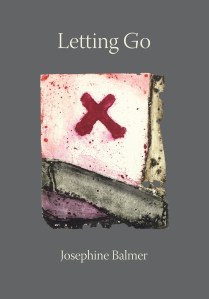
Letting Go: heart versus head

Agenda Letting Go cover

In his dialogue Phaedrus, Plato characterised rational intellect and irrational emotion as two horses pulling a chariot which their struggling charioteer, or reason, is only able to steady if, of the two, the rational was allowed to prevail.As we would now say, a case of heart versus head. Publishing two books in as many months has, at times, seemed like being on a runaway chariot, particularly as each volume is so different from the other. The Paths of Survival, which came out in April, represents a series of third-person dramatic monologues exploring the loss of literary culture. And just published today by Agenda Editions, Letting Go offers a first-person sonnet sequence articulating my own deeply personal grief at the sudden death of my mother.

And yet, as Plato suggests, these two extremes represent two halves of one whole, the personal and the universal merging through the use of ancient texts, ancient myths and ancient history which act like Plato’s steadying charioteer of the soul. So both The Paths of Survival and now Letting Go explore the process of loss and gain; the frenzy of grief and the final acceptance of the stilled heart.

In Letting Go further dichotomies are established by the weaving of ‘original’ poetry and classical versions. The following poem, for instance, represents a scene familiar to anyone who anyone who has lost a beloved parent or partner:

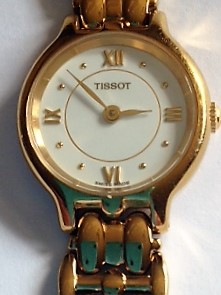
Watch

Every day measures the same as the next…

 A few months later my father spread outmum's watch
some boxes on their bed – the jewellery
we’d helped him pick for anniversaries
and birthdays that we’d now no longer count.
I chose a pair of blue agate studs, sky
blanched, sea-washed, like her eyes. And her gold watch
so that I could still feel those same hours tick
on and on, the strict time that she’d lived by.
I wanted to think of her keeping score
of each lost second, holding that cold face
to the ear for one more, and then one more;
its hushed, imperceptible breath lasting
without end, nudging us back into place –
the soothing sound of her time still passing.

Here the ‘original’ sonnet is prefaced by a quote from the ancient Greek philosopher Heraclitus. A later sonnet in the sequence ghosts a passage from Plato, Symposium 179d; the philosopher condemns the poet Orpheus’ cowardice in travelling to the Underworld alive in order to rescue his dead wife Eurydice (rather than killing himself to join her there), attributing his failure, sent by the gods in punishment, to his lack of courage.

The passage struck a chord; a short while before my mother died, I’d had open by-pass surgery – which stops the heart, albeit briefly – for a rapidly deteriorating congenital condition. Following this, like any mum, she had called by daily to cheer me up and to help me do my everyday chores as I recuperated. Just over a year later she was gone, lost to her own undiagnosed heart condition.

And so, like ‘Cancel the Invite II’ from my earlier collection, Chasing Catullus, Plato’s harsh comments could mirror my own unease at being the one to pull through, as well as the crushing agony of any bereavement. In these lines, the philosophical, the rational, is couched in the emotional language of loss as each reflects on and informs the other:

By-pass 

after Plato

Orpheus2I knew the place already. Even if
for a second, I had been there myself
as my own heart was stopped and then started
again, healed. Perhaps that was why we failed,
could only grasp at the shadows of those
we had come to save, taking the coward’s
quest – or the poet’s – seeking out pathos,
regret’s raw matter, not willing to die
in our turn: tricksters who’d somehow contrived
a way to quit the gates of Hell alive.

So the gods sent punishment we deserved;
this quagmire grief that serves as its own curse.
The pain you cannot write through or by-pass.
That feels like too little love. Or too much.


You can buy Letting Go on Amazon here (if out of stock use PoetryBooksDirect in Marketplace) or direct from Agenda here


The Scribe’s Blot

A grumpy scribe finds solace in the Greek play he is copying – and two words in particular that will survive when the rest have been lost…


scribes anticaScribes are the unsung heroes of the survival of any classical work; without them there would be no written papyrus texts and codices, and hence no fragments of drama or poetry. We know that scribes often worked from ‘scriptoriums’, maybe booths or workshops in city marketplaces where customers might request a work to be copied for their private libraries.
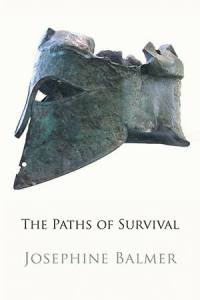
But what did the scribes themselves feel about the work they copied – and sometimes saved -for posterity? In the following poem, from my new collection The Paths of Survival, a grumpy and rather troubled scribe from second century CE Alexandria  feels he is wasting his time as he copies Aeschylus’ Myrmidons – a difficult and by now increasingly obscure text – for a socially mobile client. He knows that they will almost certainly never read the play but instead be looking to impress their friends and neighbours with their highbrow taste (while the knowledge that his customer comes from Oxyrhynchus alerts us to the fact that, far in the future, the scribe’s hard-copied text will turn up in tatters, excavated from the rubbish tips of the ancient city). And yet, as he proceeds with his work, he finds echoes of his own sorrow in Aeschylus’ tragic play – and two words that will survive when the rest have been lost…


Blot
(Alexandria, 150)

It barely matters if I blot or blotch –
these days no one asks for Aeschylus.

As light fades I head for the streets –
a cheap tavern or the house of whores –
to scrub off this stain of guilt and remorse,
flaws that cling like yesterday’s rotten fish.
On mornings after, I retake my seat,
propping up each eyelid with stylus tip,
making errors I can later edit… 

And then, today, a buyer for my script:
some pompous provincial bureaucrat
up from Oxyrhynchus with hard cash,
back-handers he’s been itching to shift.
He claims he wants High Art, Myrmidons
(though he couldn’t tell drama from dog shit –

all he cares is how it looks on the shelf).

For him I etch these words of love and grief.
I think of my wife, dead after a few weeks;
there’d been a baby, some complication,
the pockmarked physician couldn’t tell which.
I came back one night and she was gone.

Into darkness… The skin I, too, must live in.
Mistakes uncorrected, holding the blame.

The only words left now to mask the pain.
                                                                   

   Josephine Balmer

(A longer version of this poem first appeared in Arion (24.2: Fall, 2016))


shearsman-cover