The Paths of Survival

– the poetry of history –

Category: Translation

Revisiting Sappho

Sappho coverAs a translator, revisiting a text or series of texts you first worked on many years ago is always a fascinating – and daunting – task. This week Bloodaxe Books publish a new, revised edition of my Sappho: Poems and Fragments, which initially appeared with Brilliance Books in 1984, followed in 1992 by its first Bloodaxe edition. The new volume contains translations of several recent discoveries of fragments by the Greek poet, some of which offer rewritings and re-readings of previously known fragmentary poems. Others provide tantalising glimpses of  hitherto unknown fragments.

One of the new fragments in this latter group, fragment 16a (No. 124 in Sappho: Poems and Fragments), derives from a series of papyri acquired by the private Green Collection in Oklahoma City, and later published by Sappho textual scholar Dirk Obbink in 2014.  Its sparse eight lines could represent the opening stanzas of a new poem that followed fragment 16, the Ode to Anactoria, in textual editions. Alternatively, in his latest textual edition of the new fragments, Obbink has argued that this new piece might instead constitute a continuation of fragment 16 itself, a poem many editors had previously thought complete.

Whatever the truth, the new fragment’s opening stanza appears to chime with the theme and concerns of much of Sappho’s love poetry; the nature of desire and the ways in which the lover might find happiness. As Obbink has noted, it also features a typically Sapphic progression from generalised experience (‘No, it is not possible for anyone/to be completely happy…’) to that of the individual, whether or not identified as the poet herself.
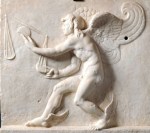
kairosThe fragment’s second stanza is far more incomplete but nevertheless contains some startling images. In line 6 of the fragment the words ep’akras, or literally ‘on the edges’, could refer to a Greek expression for ‘on tiptoes’. The following line appears to have an equally arresting reference to chion, in Homer used of fallen snow. This could evoke the figure of Kairos or ‘Opportunity’, the concept of acting at the correct time or seizing the day, which in Greek art and mythology was often portrayed as a young man running on tiptoes. But ep’akras was also used of being ‘on the edge’ of a changing season, particularly spring, which chimed with the later mention of (perhaps melting) snow. In addition, the verb which Obbink reads as ebas, or ‘you went’ echoes the eba (‘she went’) used of Helen’s desertion of Paris in fragment 16. And so I added in some conjectures here to include the image of a lover leaving like fleeting snow in the spring:


No, it is not possible for anyone
to be completely happy. And so we pray
that we might have our own small share. I myself
bear witness to this…                                                                       

[Seize the fleeting moment as it] comes to pass…  
… you went away on the brink [of spring]….
….[vanished like the melting] snow. But she…
…many things….

untitled


Letting Go: heart versus head

Agenda Letting Go cover

In his dialogue Phaedrus, Plato characterised rational intellect and irrational emotion as two horses pulling a chariot which their struggling charioteer, or reason, is only able to steady if, of the two, the rational was allowed to prevail.As we would now say, a case of heart versus head. Publishing two books in as many months has, at times, seemed like being on a runaway chariot, particularly as each volume is so different from the other. The Paths of Survival, which came out in April, represents a series of third-person dramatic monologues exploring the loss of literary culture. And just published today by Agenda Editions, Letting Go offers a first-person sonnet sequence articulating my own deeply personal grief at the sudden death of my mother.

And yet, as Plato suggests, these two extremes represent two halves of one whole, the personal and the universal merging through the use of ancient texts, ancient myths and ancient history which act like Plato’s steadying charioteer of the soul. So both The Paths of Survival and now Letting Go explore the process of loss and gain; the frenzy of grief and the final acceptance of the stilled heart.

In Letting Go further dichotomies are established by the weaving of ‘original’ poetry and classical versions. The following poem, for instance, represents a scene familiar to anyone who anyone who has lost a beloved parent or partner:

Watch

Every day measures the same as the next…

 A few months later my father spread outmum's watch
some boxes on their bed – the jewellery
we’d helped him pick for anniversaries
and birthdays that we’d now no longer count.
I chose a pair of blue agate studs, sky
blanched, sea-washed, like her eyes. And her gold watch
so that I could still feel those same hours tick
on and on, the strict time that she’d lived by.
I wanted to think of her keeping score
of each lost second, holding that cold face
to the ear for one more, and then one more;
its hushed, imperceptible breath lasting
without end, nudging us back into place –
the soothing sound of her time still passing.

Here the ‘original’ sonnet is prefaced by a quote from the ancient Greek philosopher Heraclitus. A later sonnet in the sequence ghosts a passage from Plato, Symposium 179d; the philosopher condemns the poet Orpheus’ cowardice in travelling to the Underworld alive in order to rescue his dead wife Eurydice (rather than killing himself to join her there), attributing his failure, sent by the gods in punishment, to his lack of courage.

The passage struck a chord; a short while before my mother died, I’d had open by-pass surgery – which stops the heart, albeit briefly – for a rapidly deteriorating congenital condition. Following this, like any mum, she had called by daily to cheer me up and to help me do my everyday chores as I recuperated. Just over a year later she was gone, lost to her own undiagnosed heart condition.

And so, like ‘Cancel the Invite II’ from my earlier collection, Chasing Catullus, Plato’s harsh comments could mirror my own unease at being the one to pull through, as well as the crushing agony of any bereavement. In these lines, the philosophical, the rational, is couched in the emotional language of loss as each reflects on and informs the other:

By-pass 

after Plato

Orpheus2I knew the place already. Even if
for a second, I had been there myself
as my own heart was stopped and then started
again, healed. Perhaps that was why we failed,
could only grasp at the shadows of those
we had come to save, taking the coward’s
quest – or the poet’s – seeking out pathos,
regret’s raw matter, not willing to die
in our turn: tricksters who’d somehow contrived
a way to quit the gates of Hell alive.

So the gods sent punishment we deserved;
this quagmire grief that serves as its own curse.
The pain you cannot write through or by-pass.
That feels like too little love. Or too much.


You can buy Letting Go on Amazon here (if out of stock use PoetryBooksDirect in Marketplace) or direct from Agenda here


Family Histories

330px-Gela_Painter_-_Black-Figure__Pinax__(Plaque)_-_Walters_48225As I explored previously in my 2004 collection, Chasing Catullus (and my subsequent study Piecing Together the Fragments), ancient, classical texts have long provided us with a means to articulate present grief. Five years ago this month, in November 2010, my mother died very suddenly of a heart attack. It took a long time to be able to write about this and even then, as with Chasing Catullus, I found I could do so only through the resonant echo of classical voices.

AgendaFamilyHistoriesfrontcoverJust published in the latest edition of Agenda, Family Histories, the following sonnet is based around lines from Aeneid 2 (735-55), in which Aeneas, escaping from a burning Troy with his family, realises to his horror that his wife Creusa is no longer with them.

(The full sequence, Letting Go, is published by Agenda Editions in July 2017)

Lost
(after Aeneid 2.735-55)

Up to that point, I was still in the dark.
I was retracing steps, staring down paths
I saw as ours, not knowing she had been
ripped from us already, had slipped unseen
as she sat down to rest. We’d just spoken –
I heard her laughing, hanging up the phone –
but when next we gathered, friends, family,
one of us would be missing, tricked away.
I bargained with gods I did not worship;
I blamed, I begged ambulance men, medics.
Reaching home, I tried to put on armour,
convincing myself that they had saved her,
that they had been in time, they had, they had…
In response there was only silence, dread.

Josephine Balmer

letting-go-first-pic

A New Fragment – And a New Translation: Sappho, The Cologne Fragment

220px-Tithonos_Eos_Louvre_G438_detailWhen a hitherto unknown Sappho papyrus was discovered at the University of Cologne in 2004 – and later published by Martin West in 2005 – there was huge media interest in the ‘new’ Sappho poem. However, as Sappho scholars soon recognised, most of this ‘new’ work was actually another piece of the puzzle from an existing piece of papyrus from Oxyrhynchus, fragment 58. With tattered, disputed text, scholars have had to become inured to the fact that not just their interpretation but their very content might constantly be shifting.

This means, of course, that the text we appear to have now is not the same one I translated for Sappho: Poems and Fragments thirty years ago. Nevertheless, when I was working on my, then much more incomplete poem, I felt a strong affinity to the fragment from the start; it became the one exception to my rule of not filling in the gaps, although I dutifully added a page note to the effect that ‘most of this translation is conjecture’.

Such conjecture was, of course, aided by the poem’s reference to the myth of Tithonus and Eös, the immortal Dawn who gave her lover eternal life but forgot to give him eternal youth until he was transformed into a shrivelled cicada:

…already old age is wrinkling my skin
and my hair is turning from black
to grey; my knees begin to tremble
and my legs no longer carry me…
oh, but once, once we were like young deer
…what can I do?…

                                    …it is not possible
to return to my youth; for even
Eös, the dawn, whose arms are roses,
who brings light to the end of the earth –
found that old age embraced Tithonus,
her immortal lover…
                                      …I know I must die
yet I love the intensity of life
and this, and desire, keep me here in
the brightness and beauty of the sun
[and not with Hades…]

When West’s new, more complete, text appeared in 2005, it was very gratifying to discover that, by coincidence, my conjectures followed this quite closely. If translation is an activity that occupies the realms of inspiration and creativity, as well as the pages of the dictionary, then it was also cheering to find that it embraced serendipity as well. For this reason, when I was recently asked by Peggy Reynolds to provide a version of the West’s new text for Poet in the City’s ‘Sappho…Fragments’ event at the Bloomsbury Theatre London on October 31st, so entwined were the two texts in my mind, they proved harder to disentangle than I might have thought.

In the end, to distinguish this new version from my earlier reconstruction, I decided to use rather more formal, less conversational semantics in English. But despite all efforts, I found it hard to keep to the six couplets of West’s reconstruction without writing prose lines. And so the text was transmuted into an almost-sonnet of fourteen lines. Nevertheless, thirty years – and two millennia later – it still felt as if Sappho was at my shoulder as I wrote:

The gifts of the Muses are violet-threaded,
rare: follow their path, my daughters, pursue
the lyre’s clear-voiced, enthralling song.
Once I, too, was in tender bud. Now old age
is wrinkling my skin and my hair is turning
from black to grey; my heart is weighted,
knees buckle where I danced like a deer.

Yet what else can I do but complain?
To be human is to grow old. They say
Eös, the rosy-fingered dawn, whispered,
of love to Tithonus, whirled him away
to the very edge of the world, beguiled
by his youth and beauty. Yet still he aged,
still he withered, despite his immortal wife.

Classical Versioning and the Articulation of Grief

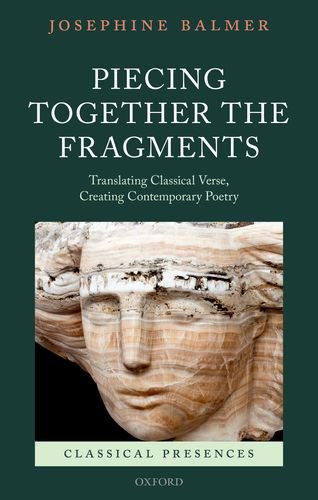
DP114272In this second taster extract from ‘Piecing Together the Fragments’, I examine the writing of my first collection, Chasing Catullus, published by Bloodaxe Books in 2004, a work which employed classical texts and versioning as a means of approaching family bereavement and grief. It is also a memorial to my niece Rachel as this week sees the seventeenth anniversary of her death. She would have been twenty-five next month.

                 Speaking Through A Text: Ovid’s Many-Headed Hydra
At the same time as exploring new ways of approaching translation and versioning, I was also grasping for a way to deal with personal grief. Just after I finished Classical Women Poets and had began to work on Catullus: Poems of Love and Hate, my sister’s then six-year-old daughter was diagnosed with aggressive stomach cancer, a period which ended tragically with my niece’s death in August 1996. I had recorded these experiences in a notebook as a means of exorcism but had put these writings aside, too painful even for myself to read. But gradually through the dark fog of bereavement, I began to write again in the only way I found that I could: through the prism of classical literature – and its translation. Similarly, it is interesting that classical scholar Thomas Van Nortwick has recorded how his study of Greek literature, particularly Homer, helped him to come to terms with the early death of a beloved nephew. As he asks himself: ‘What can Greek literature teach me about the role of gifts in the life of a spirit?’

These new poems form a diary sequence, comprising Chasing Catullus’s second, central section, which follows, both directly or obliquely, the course of my niece’s illness, its most private or difficult events articulated through the voices of classical myth and literary reference, the vocabulary through which I could begin to the unsayable. As Sullivan notes of Pound’s various literary ventriloquisms: ‘[he] realized that what he wanted to express could only be expressed in that particular way.’ In addition, Elizabeth Dodd has argued that American women poets such as H.D., Elizabeth Bishop and Louise Glück, have worked in a form of ‘personal classicism’, a means to become a woman poet in a male, literary world but at the same time to avoid the confessional tone of Anne Sexton or Sylvia Plath…

…The sequence also made use of embedded quotes from classical texts – the quotes Stephen Harrison has termed ‘appropriated’ – in order to articulate a dialogue between source text and original poem. For example, the poem, ‘Cutting the Hydra’, a proverbial expression in classical Greek for attempting an impossible task, addresses a surgeon’s initially confident but, tragically, ultimately unsuccessful attempt to remove my niece’s tumour. Here, the poem’s first stanza is based on Ovid’s account of Hercules’s slaying of the monstrous many-headed serpent, the Hydra (Metamorphoses 9. 67-78). As Hercules’ heroic confidence is deflated, its second stanza returns to my own narrative voice, referencing the later myth of Hercules, killed by his wife Deianira, who gave him a shirt dipped in the Hydra’s poisonous blood:

Cutting the Hydra

He said: “It’s child’s play, the cradle work of Junior days,
labours I’ve performed since I was little more than boy;
so if you think we can be beaten by some snake in grass,
remember, of this seething coil, you are one small part:
true, it breeds on its own death; hack away a head, any
of its many hundred necks, and two improved grow back,
fed on evil, foul branches of the serpent’s tree
but I’m its master – and what I master I destroy.”

Afterwards he couldn’t even look us in the face.
I saw him going home to his own Deianira,
tucking into cutlets, mash, one more gin with bitters,
white coat deflated on its peg, buff suit skinned and shed.

As we have seen, for Pound, such adopted selves were masks or personae, a means of speaking through another text. And in these poems, too, as in many others in the sequence, appropriating these different, classical selves allowed me to communicate the horror of the situation without directly narrating it, providing ‘the profound place to hide’ that Charles Rowan Beye has seen in the field; a slippage of self-construction and self-image, affording a means to be of myself and yet out of the self. As I noted in a 2006 paper for the ‘Self and Identity in Translation’ conference at the University of East Anglia, I needed a form that would allow me to practise deception, if not self-deception, a self-protective mechanism which could shield me from the horror of the experience described. All in all, the reality was too painful, too shocking, and ultimately too private, to be portrayed any other way except through the shifting filter of classical literature, weeding out what was or wasn’t acceptable, what might or might not be palatable, not just for the writer but for the reader too.
                                                                                                                                      Josephine Balmer

You can find more details on Piecing Together the Fragments on the OUP website here. Or pre order it on Amazon here. T51BWqT1tOsLhere is also a small article about it in the current OUP Classical Studies catalogue which you can find here.

Next time: a discussion of the issues surrounding the use of personal experience in art – and how speaking through classical texts might help us to resolve them.

Translation and the Rehabilitation of Forgotten Ancient Poetry

51BWqT1tOsL

My new book on translation and poetry, Piecing Together the Fragments: Translating Classical Verse, Creating Contemporary Poetry, will be published by Oxford University Press in September. Here is the first short taster, an extract from the section on my 1996 volume Classical Women Poets (published by Bloodaxe Books). This explores how, in conjunction with classical scholarship, translation can reanimate and rehabilitate lost fragments by forgotten ancient poets, here by Hedyle, a woman poet from Athens:


A Snatch of Sea Air: Hedyle’s ‘Scylla’
Hedyle, the only extant woman poet from Athens, was harder to track down, despite the city’s far more mainstream literary tradition. As Nancy Sorkin Rabinowitz has noted of classical Athens: ‘there were times and places more hospitable to women writers.’ Similarly, when collecting poets for her 1983 anthology, ‘Women Poets of the World’, Joanna Bankier discovered that women writers seem to flourish in ‘decentralised cultures’ but vanished under ‘a strong centralised power’ where poetry became a prestigious activity. Thought to date from the third century BC, a snatch of Hedyle’s mythological poem, ‘Scylla’, had originally been quoted by Athenaeus (7.297A) around AD 200.

But so obscure was the piece that Jane Synder’s indispensible ‘The Woman and the Lyre’ made only passing reference to it, although Diane Rayor included a literal translation in her 1991 anthology, ‘Sappho’s Lyre’, in which one Glaucus presents love gifts of ‘cockleshells from the Erythraian reef’ and ‘still unfledged halcyon chicks’ to a sea-nymph, Scylla. Through Rayor’s excellent referencing, I tracked down an edited text in ‘Supplementum Hellenisticum’. This points to a fascinating re-imagining of the myth of Homer’s six-headed sea-monster, Scylla, here seen in her youth as a beautiful girl, loved unrequitedly by the merman, Glaucus.

Hedyle’s approach appears to contrast starkly with Ovid’s version centuries later in his ‘Metamorphoses’, where Glaucus turns to the Homeric sorceress Circe for help but, falling in love with him herself, Circe jealously transforms her rival Scylla into a monster (13.904ff,14.66ff). But where Ovid’s Glaucus is overcome by sexual passion, wooing Scylla only with an account of his own troubles, Hedyle’s protagonist is tender and hesitant, furthering his suit with lover’s gifts. Meanwhile, in an engaging modern reimagining by Vicki Feaver for Michael Hofmann and James Lasdun’s influential 1994 project, ‘After Ovid: New Metamorphoses’, Scylla is a hapless bystander to Circe, who articulates her own revenge: ‘Because he wouldn’t enter me/I made her unenterable – Scylla/the nymph who fled from the god…/I wanted.’

If such texts were hard to come by, textual commentaries were practically non-existent, apart from Diane Rayor’s brief but helpful notes to her translation, in which she commented on the suitability of Glaucus’s sea-themed gifts. But, as I began to work on the piece, I found further artifice in Hedyle’s list; not just the sea imagery of corals and shells – also associated with Aphrodite, the goddess of love – but the kingfisher chicks, given by lovers in antiquity as symbols of undying love, after the myth of Alcyone who threw herself into the sea when her husband Ceyx was drowned (in the Scylla myth the rejected Glaucus also drowns himself). Kingfishers had other associations, too, namely the Greek-derived phrase ‘halcyon days’, the fourteen winter days when the birds built their nests in the calm before the storm. I incorporated this reading in to my version, stretching Hedyle’s sparse five and a half lines into two stanzas.

In the Greek, it is unclear who is the subject of the fragment’s opening lines. In my version, I transformed these into a first-person speech by Glaucus in order to foreground his lover’s emotion. This could then be contrasted to and distanced from the poet’s authorial voice which ends the extract. To me, the piece seemed a strange and beautiful fragment, concentrated, like the work of many of the women poets, around absence and loss. As I noted in my introductory comments in ‘Classical Women Poets’, in a few, brief tantalising lines, ‘Hedyle weaves a complex and ironic association of faith and betrayal, hope and disappointment, love and grief’:

Scylla

‘I brought you shells, Scylla, from clear coral reefs
and kingfisher chicks still learning how to fly –
those halcyon days to come. All these I gave
without faith, without hope.’

                                             At Glaucus’s grief
Sirens wept, his fellow dwellers of the deep;
and they swam in sorrow from their rocky shore
by simmering Etna….

You can find more details on Piecing Together the Fragments on the OUP website here. Or pre order it on Amazon here. There is also a small article about it in the current OUP Classical Studies catalogue which you can find here.

Next time: an exploration of the ways in which classical works and their translation can provide a voice through which a poet might say the unsayable.

A Saturnalia Prank

roman-banquet

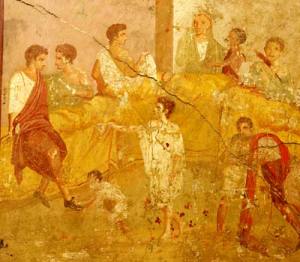
The Roman festival of Saturnalia began on 17th December, a day on which jokes were played and gifts were given, and is thought to be the origin of our own custom of Christmas gift-giving and merry-making. In the following poem (Catullus 14), first published in Bloodaxe Books’ Catullus: Poems of Love and Hate, the first century BC Roman poet Catullus receives a joke-present of a collection of bad poetry from his friend, the renowned lawyer, Licinius Calvus. Here, Catullus pretends to assume, as a wilful tease, that the verse must have been sent to Calvus as payment by one of his disreputable criminal clients; in particular, the poem mentions Vatinius, a notorious associate of Julius Caesar whom Calvus had unsuccessfully prosecuted in 54 BC (according to Seneca, during Calvus’s speech Vatinius had leapt up and protested: ‘Should I be condemned because he is so eloquent?’). Poetic jokes often seemed to have flown between Catullus and Calvus and in this poem, Catullus vows to repay Calvus’s ‘gift’ in full by sending him some worse poetry back – the doggerel versifiers Catullus singles out for mention, Caesius, Aquinus and Suffenus, are not otherwise known although Suffenus reappears in another of Catullus’s poems (22) as a writer so deluded that he buys the finest paper and high quality writing materials on which to write his execrable verse

Catullus’s Saturnalia Gift

If I didn’t love you, sweet teasing Calvus,
far more than my own eyes, then for today’s gift
I’d hate you with the hate of Vatinius;
for what have I said or done to deserve it
that you’re killing me now with all these poets?
May the gods frown down on whichever client
settled accounts with this roll of miscreants
(unless, as I suspect, it’s that school-master
Sulla, writing off debts by setting these texts,
then I bear no hate, have no complaint to make:
at least your hard work receives due recompense).
God, here’s as cursed a verse as one might expect –
a book, I know, you sent to your Catullus
to finish him off, to floor and to bore us
on Saturnalia, our day for pleasure.
No, not so fast, you can’t escape, my false friend,
for if this long night of torment ever ends
I’m off to the bookshops to buy Caesius,
Aquinus and Suffenus, all poison pens,
to pay you back in full for your own torture.
Until then, goodbye, farewell, it’s time to quit:
let those bad feet limp away, lines and couplets,
disease of the age, unreadable poets.

(translated by Josephine Balmer)

Translating Fragments I: Sappho

How do you translate tiny, sometimes one word or even one letter, fragments of ancient poetry? How far is it possible to render these as poems for contemporary readers? Such questions have long-consumed classical translators – and the search for solutions has led to riveting work, influencing not just translation but literary history as well. 

For instance, Ezra Pound and H.D. were inspired by the minimalism of fragmented verse, the reduction of a poem to pure image, which contributed to their espousal of the ‘Imagist’ movement in verse. Pound’s poem ‘Papyrus’, for example,  from his 1916 collection, Lustra, is clearly influenced by Sappho’s fragments, particularly 95:
                                                   Spring…
                                                   Too long…
                                                   Gongyla…

In my volume, Sappho: Poems and Fragments (Bloodaxe 1992), I wanted to continue in that tradition, using free, modernist verse forms which allowed lines to wander across the page like splintered conversations, incomplete declarations of love, intensifying the impact of a hanging, isolated image, of metaphor in its purest form, crystallised into a single line or even word, echoing the broken nature of the text. Tomlinson notes how Pound considered the line as ‘the unit of composition’ which led him to ‘“breaking” it … disrupting it from within’. Thirty years later, Tomlinson explains, William Carlos Williams pushed this further to ‘an idea of a poetry of line pulling against line, a line where the sense of physical is paramount, where words and groups of words make up the resistant facets of a poem’.

And so, in Sappho: Poems and Fragments, fragment 48, a couple of lines quoted in a letter by the fourth century AD Roman emperor Julian, became:

                       You’ve come and you –
                                                                 oh, I was longing for you –
                       have cooled my heart
                                                                 which was burning with desire

With some of the tiniest pieces of Sappho’s poetry, I grouped non-contiguous pieces together in my translation, regardless of their position in the Greek textual editions (themselves a construct of modern scholarship), to give them new nuances and force in English. In addition to this strategy of juxtaposition, I then adopted a policy of recontextualization, dividing my volume into new sections with titles such as ‘Love’, ‘Desire’ or Despair’.  

Of course, it has to be owned that my own decisions on the ordering and grouping of the fragments, within such emotive section headings, speak far more for my own interaction with the text than for Sappho’s now impenetrable, unknowable authorial intent. However, it was clear from the use of separate poem numberings and asterisk breaks that these were to be considered separate fragments. For example, a literal translation of fragments 36, 37, 38, 45 & 51, in their order in editions of the Greek text, would be: ‘I long and yearn’; ‘a dripping’ (the grammarian notes this was used to describe pain); ‘you roast us’;  ‘as long as you wish’; ‘I do not know what to do; I am in two minds’ . In Sappho: Poems and Fragments these became:

                                           I don’t know what to do –
                                                                        I’m torn in two
                                                      ****
                                           I desire and yearn
                                                                        [for you]
                                                    ****
                                               pain drips
                                                           through me
                                                    ****
                                             You burn me
                                                     ****
                                          As long as you wish

Through such strategies, it seemed that contemporary readers could find a way to approach the impenetrability of the text yet at the same time the fragments’ mysterious fragility could also be preserved.