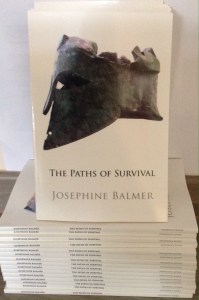
The Paths of Survival

– the poetry of history –

Category: The Paths of Survival

The Librarians’ Power

book as kindlingThis week is National Libraries Week, a celebration of the wonderful work libraries – and their librarians – do over and over again, day in, day out, offering us all free access to books, especially in these times of increasingly severe local authority budget cuts.

From classical times onwards, this work has always been highly-valued and history resonates with the grief of the loss of such institutions. The story of the destruction of the first great library at Alexandria is told over and over again, if often by sources hostile to the alleged perpetrators. We learn of the accidental fire of Julius Caesar in 48 BCE, the supposed malicious damage of rioting Christian mobs in 391 CE or even the alleged burning of the last few remaining volumes in the city’s bathhouse furnaces by its Arab conqueror Amr ibn al-Asi in 642  (the last is almost certainly apocryphal). Whatever the cause, whatever the agenda of its chroniclers, this sense of horror at the loss of the written word reverberates through the centuries.

But such devastating, wholesale destruction is not confined to the classical or early medieval era. In 2003, during the Gulf War, the famed and ancient National Library of Baghdad was set on fire by a stray incendiary bomb, illustrating how the destruction of literary culture is, sadly, still relevant to us in the twenty-first century. And how we should never take our libraries for granted.

Apart from the National Library’s own important collections, such Arabic centers of learning have always been important in preserving classical literature over the centuries, particularly scientific works. And within such works of science, small snatches of more literary texts were often quoted – and so also saved. And again, in 2003, its determined and dedicated librarians battled to recover its precious, ancient books in the aftermath of the bomb.

The following poem from The Paths of Survival was inspired by an article by Zainab Bahrani with photographs by Roger LeMoyne in the US journal Document (Spring/Summer 2013), and gives voices to those amazing Baghdad Librarians:

The Librarians’ Power

(The National Library, Baghdad, 2003)

We carried what we could to safety.

They seemed like something living:
fungus on an oak, the pleated folds
of open mushroom cup, organisms
that were once books, manuscripts,
now debris of ‘precision’ incendiary.

To conserve them we needed ice
not fire. In a ruined kitchen cellar
we found a freezer but no power;
we canvassed, coaxed, cajoled
until locals offered the sacrifice
of their one precious generator.

We were asked why we struggled
to save books while all around us
so many of our citizens were lost.
We could only say that, if not flesh,
here were dividing cells, bare blocks
of collective memory. Conscience.

The vast record of all our knowledge
and of our faith: an ancient Quran,
the House of Wisdom we had built;
the learning we alone had salvaged
and then protected for the Greeks –
Ptolemy’s Almagest, science, medicine.

Those lost worlds were retrieved
in the flash of forceps, lifting piece
on tiny piece, word on broken word.
Our own enduring, unshakeable belief
that in each newly-deciphered letter
a poem waited to be recovered.

Josephine Balmer

Letting Go: heart versus head

Agenda Letting Go cover

In his dialogue Phaedrus, Plato characterised rational intellect and irrational emotion as two horses pulling a chariot which their struggling charioteer, or reason, is only able to steady if, of the two, the rational was allowed to prevail.As we would now say, a case of heart versus head. Publishing two books in as many months has, at times, seemed like being on a runaway chariot, particularly as each volume is so different from the other. The Paths of Survival, which came out in April, represents a series of third-person dramatic monologues exploring the loss of literary culture. And just published today by Agenda Editions, Letting Go offers a first-person sonnet sequence articulating my own deeply personal grief at the sudden death of my mother.

And yet, as Plato suggests, these two extremes represent two halves of one whole, the personal and the universal merging through the use of ancient texts, ancient myths and ancient history which act like Plato’s steadying charioteer of the soul. So both The Paths of Survival and now Letting Go explore the process of loss and gain; the frenzy of grief and the final acceptance of the stilled heart.

In Letting Go further dichotomies are established by the weaving of ‘original’ poetry and classical versions. The following poem, for instance, represents a scene familiar to anyone who anyone who has lost a beloved parent or partner:

Watch

Every day measures the same as the next…

 A few months later my father spread outmum's watch
some boxes on their bed – the jewellery
we’d helped him pick for anniversaries
and birthdays that we’d now no longer count.
I chose a pair of blue agate studs, sky
blanched, sea-washed, like her eyes. And her gold watch
so that I could still feel those same hours tick
on and on, the strict time that she’d lived by.
I wanted to think of her keeping score
of each lost second, holding that cold face
to the ear for one more, and then one more;
its hushed, imperceptible breath lasting
without end, nudging us back into place –
the soothing sound of her time still passing.

Here the ‘original’ sonnet is prefaced by a quote from the ancient Greek philosopher Heraclitus. A later sonnet in the sequence ghosts a passage from Plato, Symposium 179d; the philosopher condemns the poet Orpheus’ cowardice in travelling to the Underworld alive in order to rescue his dead wife Eurydice (rather than killing himself to join her there), attributing his failure, sent by the gods in punishment, to his lack of courage.

The passage struck a chord; a short while before my mother died, I’d had open by-pass surgery – which stops the heart, albeit briefly – for a rapidly deteriorating congenital condition. Following this, like any mum, she had called by daily to cheer me up and to help me do my everyday chores as I recuperated. Just over a year later she was gone, lost to her own undiagnosed heart condition.

And so, like ‘Cancel the Invite II’ from my earlier collection, Chasing Catullus, Plato’s harsh comments could mirror my own unease at being the one to pull through, as well as the crushing agony of any bereavement. In these lines, the philosophical, the rational, is couched in the emotional language of loss as each reflects on and informs the other:

By-pass 

after Plato

Orpheus2I knew the place already. Even if
for a second, I had been there myself
as my own heart was stopped and then started
again, healed. Perhaps that was why we failed,
could only grasp at the shadows of those
we had come to save, taking the coward’s
quest – or the poet’s – seeking out pathos,
regret’s raw matter, not willing to die
in our turn: tricksters who’d somehow contrived
a way to quit the gates of Hell alive.

So the gods sent punishment we deserved;
this quagmire grief that serves as its own curse.
The pain you cannot write through or by-pass.
That feels like too little love. Or too much.


You can buy Letting Go on Amazon here (if out of stock use PoetryBooksDirect in Marketplace) or direct from Agenda here


Final Sentence

img_0296

It is always a hugely exciting time when the hard work of several years is distilled into a written text. For this celebratory post on the publication of The Paths of Survival, as in the book, I’d like to begin at the end with a tattered piece of papyrus in the collection of an Oxford University library. Oxyrhynchus Papyrus 2256 contains nearly 90 scraps of papyrus. Of these, number 55 constitutes four, barely legible half-lines of  Aeschylus’ lost play Myrmidons. Part of its text could read ‘kata skoton’ or ‘into darkness’ – a snatch, maybe, of the lover’s lament Achilles murmurs over Patroclus’ dead body. Here is the homoerotic passion which later rendered Myrmidons such a difficult and controversial work, probably sealing its demise (and a link, too, to the copy my fictional scribe is making, centuries earlier, in ‘Blot’ and then its disposal on the rubbish piles of Oxyrynchus in ‘The Pagan’s Tip’) .

POxy 2256 frag 55 (2)

It is, of course, heart-breaking that, along with a handful or so of similar fragments, this is all we have left of Aeschylus’ tragic masterpiece. It is also a warning that our own cultures might be far more fragile than we think. Yet in each small miracle of survival, there is always something to celebrate. For somehow, by judgement or by error but mostly through happenstance, something of the written text, of literary culture, however damaged, however minuscule, has managed to escape all those centuries of ignorance, war, persecution and destruction. Like the lined faces of  the old, each crease and blemish tells a unique story of experience and endurance. Proof that words can – and do – thrive where all else is lost.


Final Sentence

(Sackler Library, Oxford, Present Day)

Still I am drawn to it like breath to glass.
That ache of absence, wrench of nothingness,
stark lacunae we all must someday face.

I imagine its letters freshly seared;
a scribe sighing over ebbing taper,
impatient to earn night’s coming pleasures
as light seeped out of Alexandria.

But in these hushed corners of Oxford
Library afternoons, milky with dust,
the air is weighted down by accruing loss

and this displaced scrap of frayed papyrus
whose mutilated words can just be read,
one final, half-sentence: Into darkness…
Prophetic. Patient. Hanging by a thread.

Josephine Balmer

The Paths of Survival is published by Shearsman.  You can order a copy  here or here.

shearsman-cover