
Ghost Passage: Poetry as Archaeology

Today is the publication day of my new collection, Ghost Passage, from Shearsman Books. These poems are inspired by writing that stands outside the usual preconceptions of literature: inscriptions, graffitied household objects, and a cache of Roman writing tablets recently excavated at the Bloomberg site in the City of London. From these incomplete and fragmentary remnants of everyday life, I have teased out the stories of those who might have written them, extrapolating outwards to fill the space and silence that surrounds them. To explore history – and poetry – from the ground up.
This is where the ‘objectivity’ of archaeology and the ‘subjectivity’ of poetry overlap. Like poets, archaeologists seek to uncover lost fragments of human existence, the detritus we leave behind, whether physical or emotional. They forge connections between past and present, inevitably and inescapably reading that past in terms of our present. And where archaeology excavates beautiful, lost objects, long-buried in the accumulating silt of history, poetry excavates language, particularly image and metaphor, from the dusty inspiration of time and place. Both meticulously brush away the dirt to restore the colour and vibrancy to long-forgotten or discarded artefacts. Above all, both seek to reconstruct the tattered fragments, to rebuild the fallen cities, to give breath to the silent voices.
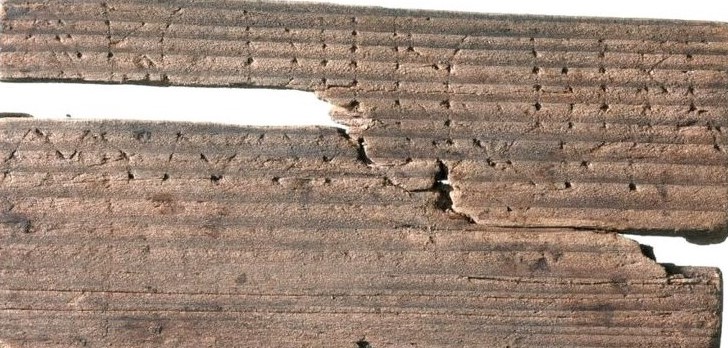
The following sonnet from the collection, “New Roman”, is based on Bloomberg Writing Tablet 79. This is scored simply with a Roman alphabet and apparently used for teaching letters. It probably dates from c.61/2 CE, just after London’s destruction by Boudicca. My inspiration here was the rebuilding of a city after war, especially as I was working on the poem after watching news reports on children in Syrian refugee camps, desperate to return to school:
New Roman
Walbrook, London 61 CE
ABCDEFGHIKL
MNOPQRST…
In a charred shack we learn our lessons.
Through the smoke I can smell sorrel, ramsons,
blackthorn blossom drifting across like ash
as the shouts of soldiers shatter our hush
and wagons of the dead still roll on past.
We do not want this world, the old language:
destruction, put to fire, revolt, flight, death.
Our task is to etch a new alphabet –
new letters, new tools to rebuild our homes,
gardens for us children, games to play, schools.
We’ll smooth the jagged edge of dialect
and salve its gaping wounds in majuscule.
A-B-C: the scorched march of New Roman
turning blackened wood into cold white stone.
Josephine Balmer
For other poems from the collection on this blog, see here, here and here.

 In 60 CE, nearly twenty years after the Roman emperor Claudius had annexed Britain, British tribes led by the Iceni Queen Boudica revolted against their Roman conquerors. In his account of the rebellion, the Roman historian Tacitus describes how the British first turned their attention to the city of Camulodunum, modern Colchester, razing it to the ground, before marching on Londinium or London.
 The following poem, first published in the New Statesman earlier this year (18th April) is written in the voice of Suetonius Paulinus. It follows firstly Greek historian Cassius Dio’s description (63) of the portents that preceded Boudica’s attack and then Tacitus’s own account in his Annals (14.33) which pinpoints the human cost of Suetonius’s decision:

 A year or so ago, while on holiday in the Derbyshire Peak District, my husband bought me a pair of blue john earrings from one of the many jewellers in the village of Castleton. Castleton is extremely proud of its blue john, and is the only place in the country where the stone occurs, so we were also presented with a leaflet about its history. This claimed blue john had first been mined by the Romans and even mentioned by the ancient historians Pliny and Tacitus. These, we read, record how the first century AD Roman writer and sensualist, Petronius, author of the Satyricon, one of the earliest novels in literature, had owned a precious chalice made of the Derbyshire stone.
 Intrigued, I tracked down the passages in both authors (Tacitus Annals, 17.18-19 & Pliny Natural History 37.7) who both recounted how, before comitting suicide after an accusation of treason, Petronius had destroyed his valuable cup so that the emperor Nero could not subsequently possess it. Of course, as it so often the case with anecdotal evidence, scholarship was more sceptical that Petronius’s cup was made of blue john; for while the Romans undoubtedly mined British metals and stone – some of the resources that first drew them to the island – Pliny’s description of the chalice as ‘myrrhinam’ has been taken to refer to an imported Chinese porcelain, hence its high value. But for the purposes of poetry rather than scholarship, this connection between a sophisticated, urbane writer and courtier at the very centre of the Roman empire and a tiny Peakland outpost on its northerly British edge seemed too fascinating to eschew, as the following poem explores. First published in
 In his Letters (3.16), Pliny tells the story of the first century AD Roman matron Arria, whose husband and young son both fell gravely ill at the same time. When her son died, Pliny records, Arria did not tell her husband, Caecina Paetus, concerned that the news would be detrimental to his own recovery, instead mourning the loss of her son alone. But the real story comes some years later when Paetus took part in a failed revolt against the emperor Claudius. Apparently he then hesitated before taking the honourable way out, suicide. Arria was not so cowardly. As Pliny recounts, she plunged the sword in her own breast first, reassuring her wavering husband that it would be painless – words that later seem to have become proverbial in Latin. For Pliny, Arria is a dutiful Roman wife, heroically standing by her husband no matter what. The following poem, first published in
 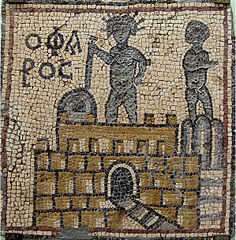 Two years before his death in 217AD (see my previous entry), the Roman emperor Caracalla had perpetrated an act of extreme savagery against the citizens of ancient Alexandria in revenge for their satires about him. In particular, the Alexandrians were said to be making gibes about the fact that Caracalla had murdered his brother – and then co-emperor – Geta in front of their own mother whom, it was rumoured, he then planned to marry. Caracalla’s revenge was not only brutal but, according to surviving accounts by ancient historians Dio Cassius and Herodian, reveals many chilling similarities with the actions of more modern despots. For instance, Caracalla’s duplicity and delight in tricking the Alexandrians into watching the massacre of all of the city’s young men, his lack of remorse at his bloodthirsty actions, his pretensions to culture, and his subsequent ‘walling-in’ of Alexandrian neighbourhoods, like an ancient version of the Warsaw Ghetto, all seem terrifyingly recognizable today. The poem appears in my collection,
  The Paths of Survival