
Parallel Griefs, Ancient and Modern
 Next Saturday, on Anzac Day, Australians and New Zealanders around the world will gather at Anzac Cove on the Gallipoli peninsula, Turkey, to remember, one hundred years on, their compatriots who landed here in April 1915 during the bloody – and ill-fated – First World War campaign. But less well-known is the involvement of British soldiers, landing at Helles to the south of the peninsular and later, in August 1915, at Suvla to the north.
Strangely, perhaps, I stumbled on the stories of these British soldiers while working on Ovid’s Tristia, the verses written after the Roman poet’s sudden and mysterious exile from Rome to the Black Sea in AD 8. For my translations, I was using Perseus, Tufts University’s excellent online 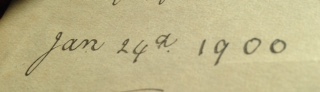 classical library and lexica, when a sudden electrical storm required me to log off from the internet. Instead, I took down an old second-hand Latin dictionary I had bought at a village fair as a student. Here, as if for the first time, I noticed a name inked faintly on its fly-leaf, with a date, January 1900. A few internet searches revealed that my dictionary’s original owner had later fought with the Royal Gloucester Hussars at Suvla on Gallipoli, near to Ovid’s own place of exile on the Black Sea.
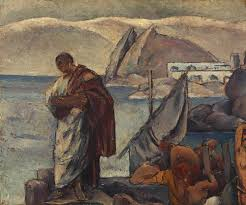 My subsequent poetry collection The Word for Sorrow (Salt, 2009), interspersed versions of Tristia with original poems tracing the story of my old second-hand dictionary being used to translate them. Presenting Ovid’s story in parallel with that of the Gallipoli soldiers, as well as narrating my own progress as I uncovered the past like a detective, seemed to provide a new way to approach the perhaps over-familiar subject of the First World War; to celebrate the sometimes surprising ties of grief we all share, whether we live at the beginning of the first, the twentieth or the twenty-first century AD.
Here are two poems from the collection; in the first, based around contemporary eye-witness accounts and regimental war diaries, the RGH land at Suvla on August 18th 1915. In the second, the exiled and despairing Ovid dreams of Rome.
Landed
(I never knew blood smelt so strong…)
For a prize of dirt, few square yards of scrub,
they fought like gods as soil soaked red,
shallows curdled, stagnant with corpse-shoals.
Across Suvla plain, Geoffrey’s men marched out,
without maps, with no idea where to attack,
a storm-spray of chalk and dust and blood –
too dense, too dark to tell if theirs or ours.
They crawled back like ghosts, skin singed,
clothes in tatters, tongues burnt black,
press-ganged workers after abattoir nightshift;
some spoke only in whimpers, others cried
for comrades mown down by unseen scythe,
smouldering khaki all that marked the spot.
Now the dried salt lake brimmed with body parts
as if netted by fishermen’s bumper catch:
Englishmen. Dead Englishmen. Hundreds of them.
We’d never seen a corpse before and here they were,
stacked like logs or mackerel on moon-blanched shore,
mouths open, eyes wide, all just staring back,
our horror reflected in each gasping, glassy face.
We thought of home. It seemed a happy place.
Naso Off the Shelf
(from Ovid Tristia, 3.1)
I dreamt my book went home again,
transformed, reformed, shuddering
like Proteus on the turn, changing shape;
no longer versed in youth’s green passion
but old age’s brown and shrivelled hate,
bound in sadness, grief’s dark script.
And I walked with it through my city’s
empty squares, footsteps soft as leaf-
fall on glittering autumn streets,
unfolding the faded map of my past life:
the Forum, the Sacred Way, the Palatine,
statues, temples, stacked libraries,
where all great works, ancient or modern,
can be read by any who might seek.
Now my book, too, tried to enter
as a guard blocked its dragging feet.
On tip-toe, noses pressed on misted pane,
we saw the touch of smoothing hand
but not for us – these lines are banned.
We heard the hush of unrolled volumes
but not of ours – by far the worst exile for them:
The shame is mine, of my Ars amatoria;
it stains each new page, sins of their father.
I talked too long of love, that was my ‘crime’
yet my ‘error’ was to see and not speak out.
And so my book is closed, my heart has died.
Poetry must, poetry can only tell the truth.
In life we have to lie to stay alive.
Josephine Balmer
Find out more about The Word for Sorrow here 


 The Paths of Survival