The Paths of Survival

– the poetry of history –

Category: Fragments

Revisiting Sappho

Sappho coverAs a translator, revisiting a text or series of texts you first worked on many years ago is always a fascinating – and daunting – task. This week Bloodaxe Books publish a new, revised edition of my Sappho: Poems and Fragments, which initially appeared with Brilliance Books in 1984, followed in 1992 by its first Bloodaxe edition. The new volume contains translations of several recent discoveries of fragments by the Greek poet, some of which offer rewritings and re-readings of previously known fragmentary poems. Others provide tantalising glimpses of  hitherto unknown fragments.

One of the new fragments in this latter group, fragment 16a (No. 124 in Sappho: Poems and Fragments), derives from a series of papyri acquired by the private Green Collection in Oklahoma City, and later published by Sappho textual scholar Dirk Obbink in 2014.  Its sparse eight lines could represent the opening stanzas of a new poem that followed fragment 16, the Ode to Anactoria, in textual editions. Alternatively, in his latest textual edition of the new fragments, Obbink has argued that this new piece might instead constitute a continuation of fragment 16 itself, a poem many editors had previously thought complete.

Whatever the truth, the new fragment’s opening stanza appears to chime with the theme and concerns of much of Sappho’s love poetry; the nature of desire and the ways in which the lover might find happiness. As Obbink has noted, it also features a typically Sapphic progression from generalised experience (‘No, it is not possible for anyone/to be completely happy…’) to that of the individual, whether or not identified as the poet herself.
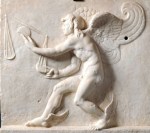
kairosThe fragment’s second stanza is far more incomplete but nevertheless contains some startling images. In line 6 of the fragment the words ep’akras, or literally ‘on the edges’, could refer to a Greek expression for ‘on tiptoes’. The following line appears to have an equally arresting reference to chion, in Homer used of fallen snow. This could evoke the figure of Kairos or ‘Opportunity’, the concept of acting at the correct time or seizing the day, which in Greek art and mythology was often portrayed as a young man running on tiptoes. But ep’akras was also used of being ‘on the edge’ of a changing season, particularly spring, which chimed with the later mention of (perhaps melting) snow. In addition, the verb which Obbink reads as ebas, or ‘you went’ echoes the eba (‘she went’) used of Helen’s desertion of Paris in fragment 16. And so I added in some conjectures here to include the image of a lover leaving like fleeting snow in the spring:


No, it is not possible for anyone
to be completely happy. And so we pray
that we might have our own small share. I myself
bear witness to this…                                                                       

[Seize the fleeting moment as it] comes to pass…  
… you went away on the brink [of spring]….
….[vanished like the melting] snow. But she…
…many things….
untitled


The Librarians’ Power

book as kindlingThis week is National Libraries Week, a celebration of the wonderful work libraries – and their librarians – do over and over again, day in, day out, offering us all free access to books, especially in these times of increasingly severe local authority budget cuts.

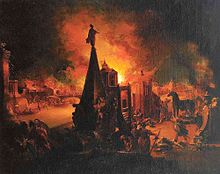
From classical times onwards, this work has always been highly-valued and history resonates with the grief of the loss of such institutions. The story of the destruction of the first great library at Alexandria is told over and over again, if often by sources hostile to the alleged perpetrators. We learn of the accidental fire of Julius Caesar in 48 BCE, the supposed malicious damage of rioting Christian mobs in 391 CE or even the alleged burning of the last few remaining volumes in the city’s bathhouse furnaces by its Arab conqueror Amr ibn al-Asi in 642  (the last is almost certainly apocryphal). Whatever the cause, whatever the agenda of its chroniclers, this sense of horror at the loss of the written word reverberates through the centuries.

But such devastating, wholesale destruction is not confined to the classical or early medieval era. In 2003, during the Gulf War, the famed and ancient National Library of Baghdad was set on fire by a stray incendiary bomb, illustrating how the destruction of literary culture is, sadly, still relevant to us in the twenty-first century. And how we should never take our libraries for granted.

Apart from the National Library’s own important collections, such Arabic centers of learning have always been important in preserving classical literature over the centuries, particularly scientific works. And within such works of science, small snatches of more literary texts were often quoted – and so also saved. And again, in 2003, its determined and dedicated librarians battled to recover its precious, ancient books in the aftermath of the bomb.

The following poem from The Paths of Survival was inspired by an article by Zainab Bahrani with photographs by Roger LeMoyne in the US journal Document (Spring/Summer 2013), and gives voices to those amazing Baghdad Librarians:

The Librarians’ Power

(The National Library, Baghdad, 2003)

We carried what we could to safety.

They seemed like something living:
fungus on an oak, the pleated folds
of open mushroom cup, organisms
that were once books, manuscripts,
now debris of ‘precision’ incendiary.

To conserve them we needed ice
not fire. In a ruined kitchen cellar
we found a freezer but no power;
we canvassed, coaxed, cajoled
until locals offered the sacrifice
of their one precious generator.

We were asked why we struggled
to save books while all around us
so many of our citizens were lost.
We could only say that, if not flesh,
here were dividing cells, bare blocks
of collective memory. Conscience.

The vast record of all our knowledge
and of our faith: an ancient Quran,
the House of Wisdom we had built;
the learning we alone had salvaged
and then protected for the Greeks –
Ptolemy’s Almagest, science, medicine.

Those lost worlds were retrieved
in the flash of forceps, lifting piece
on tiny piece, word on broken word.
Our own enduring, unshakeable belief
that in each newly-deciphered letter
a poem waited to be recovered.

Josephine Balmer

The Pagan’s Tip

A family in fourth century CE Oxyrhynchus decides it is time to dispose of their library of classical, pre-Christian texts…


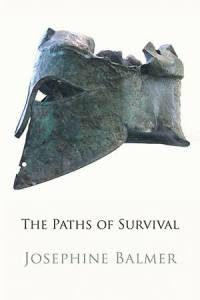
romanshelf libraryIn my last post, a fictional Alexandrian scribe copied lines of Aeschylus’ Myrmidons for a cash-rich family from Oxyrhynchus. Here, in another poem from my forthcoming collection, The Paths of Survival, we move on in time another two centuries to find his customer’s descendants deciding that, in a Christian empire, it is time to make a gesture.

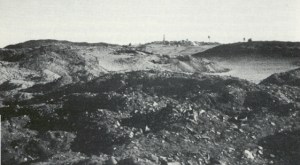
oxysite rubbish mounds at oxyrhynchusIn particular, they feel, it would be politic to dump the works in their treasured family library on the town rubbish tip – including the copies of Aeschylus’ tragedies our cantankerous scribe had worked so hard to produce for them. Here, of course, the papyri will later be excavated in tattered strips by late nineteenth and early twentieth century archaeologists, beginning the painstaking process of piecing what little might remain of those texts back together…:
 

The Pagan’s Tip
(Oxyrhynchus, Upper Egypt, 370)

Today we sacrificed our last bull –
not easy with just the five of us.
Walking back with Kallas, my cousin,
we both agreed it was time to stop.
Now, we said, we are all Christians.

That night I gathered up the volumes
my family had prized over the years:
philosophy, poetry, the great dramas
of Aeschylus, epigrams of Palladas –
works our ancestor had bought home
in triumph from a trip to Alexandria.

Those pages hold our history like maps.
If I run my fingers over the covers,
their gold letters and tooled leather,
I can trace the twisted paths of our past.
This is who we were and what we are:
grammarians, clerks, petty bureaucrats.

On the shelf I replaced each space
with Paul’s Epistles, all the Gospels.
Ours I took out beyond the walls
among the flies and rotting waste,
left them there for the rats to soil
like any piece of discarded refuse.

Do the same, if you want my advice.

Josephine Balmer

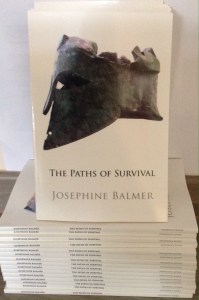
The Paths of Survival will be published by Shearsman on April 7th.

shearsman-cover

Final Sentence

img_0296

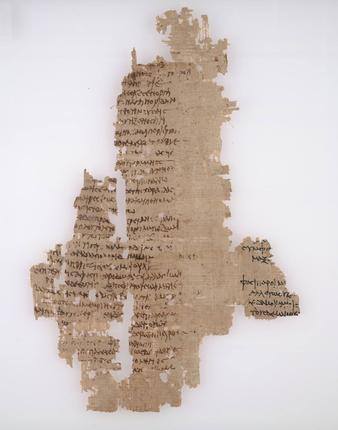
It is always a hugely exciting time when the hard work of several years is distilled into a written text. For this celebratory post on the publication of The Paths of Survival, as in the book, I’d like to begin at the end with a tattered piece of papyrus in the collection of an Oxford University library. Oxyrhynchus Papyrus 2256 contains nearly 90 scraps of papyrus. Of these, number 55 constitutes four, barely legible half-lines of  Aeschylus’ lost play Myrmidons. Part of its text could read ‘kata skoton’ or ‘into darkness’ – a snatch, maybe, of the lover’s lament Achilles murmurs over Patroclus’ dead body. Here is the homoerotic passion which later rendered Myrmidons such a difficult and controversial work, probably sealing its demise (and a link, too, to the copy my fictional scribe is making, centuries earlier, in ‘Blot’ and then its disposal on the rubbish piles of Oxyrynchus in ‘The Pagan’s Tip’) .

POxy 2256 frag 55 (2)

It is, of course, heart-breaking that, along with a handful or so of similar fragments, this is all we have left of Aeschylus’ tragic masterpiece. It is also a warning that our own cultures might be far more fragile than we think. Yet in each small miracle of survival, there is always something to celebrate. For somehow, by judgement or by error but mostly through happenstance, something of the written text, of literary culture, however damaged, however minuscule, has managed to escape all those centuries of ignorance, war, persecution and destruction. Like the lined faces of  the old, each crease and blemish tells a unique story of experience and endurance. Proof that words can – and do – thrive where all else is lost.


Final Sentence

(Sackler Library, Oxford, Present Day)

Still I am drawn to it like breath to glass.
That ache of absence, wrench of nothingness,
stark lacunae we all must someday face.

I imagine its letters freshly seared;
a scribe sighing over ebbing taper,
impatient to earn night’s coming pleasures
as light seeped out of Alexandria.

But in these hushed corners of Oxford
Library afternoons, milky with dust,
the air is weighted down by accruing loss

and this displaced scrap of frayed papyrus
whose mutilated words can just be read,
one final, half-sentence: Into darkness…
Prophetic. Patient. Hanging by a thread.

Josephine Balmer

The Paths of Survival is published by Shearsman.  You can order a copy  here or here.

shearsman-cover

The Scribe’s Blot

A grumpy scribe finds solace in the Greek play he is copying – and two words in particular that will survive when the rest have been lost…


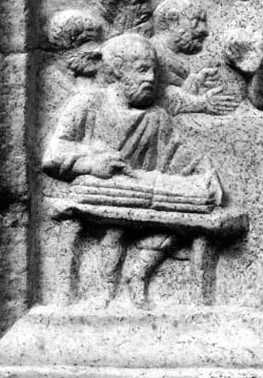
scribes anticaScribes are the unsung heroes of the survival of any classical work; without them there would be no written papyrus texts and codices, and hence no fragments of drama or poetry. We know that scribes often worked from ‘scriptoriums’, maybe booths or workshops in city marketplaces where customers might request a work to be copied for their private libraries.
But what did the scribes themselves feel about the work they copied – and sometimes saved -for posterity? In the following poem, from my new collection The Paths of Survival, a grumpy and rather troubled scribe from second century CE Alexandria  feels he is wasting his time as he copies Aeschylus’ Myrmidons – a difficult and by now increasingly obscure text – for a socially mobile client. He knows that they will almost certainly never read the play but instead be looking to impress their friends and neighbours with their highbrow taste (while the knowledge that his customer comes from Oxyrhynchus alerts us to the fact that, far in the future, the scribe’s hard-copied text will turn up in tatters, excavated from the rubbish tips of the ancient city). And yet, as he proceeds with his work, he finds echoes of his own sorrow in Aeschylus’ tragic play – and two words that will survive when the rest have been lost…


Blot
(Alexandria, 150)

It barely matters if I blot or blotch –
these days no one asks for Aeschylus.

As light fades I head for the streets –
a cheap tavern or the house of whores –
to scrub off this stain of guilt and remorse,
flaws that cling like yesterday’s rotten fish.
On mornings after, I retake my seat,
propping up each eyelid with stylus tip,
making errors I can later edit… 

And then, today, a buyer for my script:
some pompous provincial bureaucrat
up from Oxyrhynchus with hard cash,
back-handers he’s been itching to shift.
He claims he wants High Art, Myrmidons
(though he couldn’t tell drama from dog shit –

all he cares is how it looks on the shelf).

For him I etch these words of love and grief.
I think of my wife, dead after a few weeks;
there’d been a baby, some complication,
the pockmarked physician couldn’t tell which.
I came back one night and she was gone.

Into darkness… The skin I, too, must live in.
Mistakes uncorrected, holding the blame.

The only words left now to mask the pain.
                                                                   

   Josephine Balmer

(A longer version of this poem first appeared in Arion (24.2: Fall, 2016))


shearsman-cover


Palladas: The Other Half Speaks Out Part II

Palladas papyrusIn the second part of this blog on my new versions of Palladas (see previous post), commissioned for a conference at UCL, I would like to move on to the poems from the newly-discovered papyrus. Due to their far more fragmentary nature, these were a harder, but equally, perhaps, a more intriguing task. That said, with the help of Kevin Wilkinson’s excellent, recently-published commentary, I found their voices soon slipped into place.

The first fragment I worked on was p.13 lines 18-32. Here is a literal translation, which at very glance looks very obscure indeed:
Another one against [?] slavish [?]…
Beans, which are now called faba…Very hateful indeed to Pythagoras of Samos. We will continue to hold to that man’s warning: that it is equivalent…both to eat beans and the heads of our fathers…related..melted in fire. .the most ridiculous thing… and the flesh of four-footed animals…food…Pythagoras…very much indeed…Pythagoras…take on…all kinds of food..
Fortunately, Kevin Wilkinson’s commentary provided a way in, explaining most of the poem’s obscurities as satirical references to Pythagorean practices and beliefs – their caveats against eating beans, as evidenced by Pythagoras’ famous dictum that to do so would be ‘like eating the head of one’s father’, as well as their abstention from alcohol and meat. And so these perplexing pieces could form into some sort of sense, illustrating how scholarship and creativity can work together:

Against Slavish Fads
Flageolets (which used to be plain ‘beans’)
Are never, ever eaten by the Pythagoreans.
They all defer to the great man’s dictums:
Dining on beans, it seems, is prohibited –
Like boiling dear old Dad’s bald head.
And alcohol? Well, that too is verboten:
As fire melts iron, they say, so wine, wisdom.
You ask what could be more ridiculous?
They also hate meat, disdain its finest cuts. 

God help the woman who takes on the task
Of shopping – or even catering – for Pythagoras. 

The next fragment was possibly even more problematic with only five half-lines surviving. Although here we seem to be back in very familiar Palladas territory – the deviousness of women. This is a literal translation:
Alas, o respectable woman, the…clever hair-splittings…if, on account of the rich…and their wives…. but you…just the same…
And this is the new poem I fashioned out of these various scraps:

On Honour Among Wives
 ‘Respectable’ women are the ones to beware;
They open their legs and then they split hairs
With such clever talk about ‘minor infidelities’ –
What constitutes ‘cheating’, or counts as a ‘lie’.
The rich, most of all, should proceed with care,
Those wealth creators – at least for their wives.
You think you bought a spouse, a slave in name?
You know what your wife thinks? Just the same.

 My next chosen fragment was page 18, lines 1-9. Its literal translation – such as it is – reads as follows:
…is weakened, for the help from… I babble…and a mist steals over my eyes…my…is being supported [nourished? well-grown?] …to the soles of my feet…I am becoming paler…it will be necessary for one who has fainted [or endured?]…
Despite its apparent obscurity, I found this piece fascinating. As Kevin Wilkinson notes, it echoes Sappho fragment 58, in which she describes the adverse effects of old age, such as the weakening of the knees. But I was also reminded of Sappho fragment 31, which lists the various physical symptoms of passion.  So these Sappho fragments became another intertextual reference for my version, which, in turn, became a mash-up of both Sappho and Palladas. Again, it offers a male narrative voice, if slightly lacking, I think it is fair to say, in self-awareness:

Love in Old Age
As soon as I sit next to her, my bones creak;
There’ s no help for it as my knees turn weak.
My words tangle, my tongue lisps and twists;
My voice grates – and then her eyes start to mist.
My pot belly swells, begins to quiver –
A fine figure (if I don’t look in mirror).
A fire shoots down to the tip of my toes
As my gout flares up, takes its endless hold.
I seem to fade away, I am paler
Than stale piss, faint from high blood pressure…  

But believe you me, all can be lived through –
For even an old man might one day pull…

My final version of Palladas was one of the more complete poems on the papyrus, p.10 lines 24-9, which, as Kevin Wilkinson points out, poses a philosophical question and then satirically answers itself:
Another One…
If we wish to put an end to the discord and the strife, I would like to introduce a motion, a truly marvellous one: let us appoint ambassadors to go down to Pluto. – Whom, then, shall we persuade? – It’s not impossible. Pay out five talents and Heron will be persuaded again.
No one is quite sure who this Heron in the last line might have been, or why he gained a reputation for taking on any diplomatic task, however unlikely – providing the price was right. But immediately I saw a perfect modern analogy for the unknown Heron. There is also a touch of Blackadder’s Baldrick in the translation here too…:

Another Cunning Plan
If we want to end conflict, put peace in place,
I have a cunning plan, yes, truly otherworldly:
Send envoys down to all the soldiers in Hades;
Canvass those who paid the price, face to face.
But who might undertake the task? No worries.
Put up five million – and Tony Blair is on the case.

With thanks to the conference organisers – Professor Edith Hall of Kings College, London and Professor Chris Carey and Dr Maria Kanellou of University College, London. And to Professor Kevin Wilkinson for all his exhaustive work on the papyrus.

Palladas: The Other Half Speaks Out I

Palladas picThese versions of Palladas were commissioned for ‘Palladas: The New Papyrus’, an international conference held at  University College, London on 4th-5th September 2014. This centred on the discovery of a new codex containing around 60 new epigrams (possibly!) by the fourth (or maybe fifth?) century AD Alexandrian poet. These have recently been published with an exhaustive commentary by Professor Kevin Wilkinson of  the University of Toronto.

After reading the poems, I decided that my versions could only answer the ill-tempered misogyny for which Palladas is famed. Hence my title, The Other Half Speaks Out. I also decided to work both on some of the older epigrams, long collected in the Greek Anthology, as well as some of the new, mostly very fragmentary poems from the papyrus.

My first version was of Palladas 9.773, a famous epigram, often taken to refer to the triumph of Christianity over paganism. Here the poet imagines a statue of the Greek love god Eros, melted down into a frying pan, presumably now superfluous to requirements in a predominantly Christian world. A literal translation of this is as follows:
A bronze-smith, melting down Eros, fashioned a frying pan – not unreasonably, since that too burns.
But as I began to work on the poem, it occurred to me that the juxtaposition of love, frying pans – and burning – might have extra resonances for women readers. This was my new version:

From Fat to Frying Pan
First he burned with words, kisses;
Promising a life together, a few kids.
And then it was: where’s my breakfast?
Or, I don’t like my eggs done like this.
Time, like an alchemist or blacksmith,
Has hammered out love, our own Eros,
Shrunk it down, from fat to frying pan.
Never mind: now it is my turn to burn
The best bacon. To waste his good eggs.

My next new version was after 11.287, one of Palladas’ most difficult poems for a woman translator (and/or reader) to approach. In fact, when I Googled it for a text, the first heading that came up was ‘Patriarchal Male Fantasy’. The literal translation shows why:
Cursed with an ugly wife, when he lights the evening candles, he still sees only gloom
In my version, the woman, that wife, responds to her particular charmer of a husband:

Holding a Candle
When I hear his step on the stair,
See the flicker of the evening light
On his yellow teeth or thinning hair
As he peers into that gloomy night,
I turn my face to the peeling wall.
I dream of the lips of my first love
While he snores on or snuffles off.
 He couldn’t even hold a candle.

My final version of an ‘old’ poem, was 11.306. Literally translated, this reads:
Even if, after Alexandria, you leave for Antioch, and, after Syria, you then arrive in Italy, no powerful man will marry you; for ever in hope, you will hop from city to city.
This put me in mind straightaway of another, much more modern Alexandrian poet, C.P. Cavafy, and, in particular, his famous poem, ‘The City’. I therefore decided to filter my response to Palladas  through the prism of Cavafy, using the latter modern poet’s trademark direct reported speech form.  But I also added a coda, a response from the woman quoted:

 All the Same
(i)
You might say: ‘Time to look for another spot,
Kiss goodbye to Alexandria, head for Antioch
Or Italy – to find a man who is rich and powerful
(Or both).’ But just as you are unmarriageable
In this one city, so you will always be alone
As you hop from bed to bed, time zone to time zone.
(ii)
Yes, I’m the woman who’s had her fair ration –
From A to A, I have run the full gamut of men:
The losers, the liars, the cheats without shame.
Here’s a flash: world over, they’re all the same.

With thanks to the conference organisers – Professor Edith Hall of Kings College, London and Professor Chris Carey and Dr Maria Kanellou of University College, London – for their generous hospitality.

Next time: versions of Palladas’ new poems


A New Fragment – And a New Translation: Sappho, The Cologne Fragment

220px-Tithonos_Eos_Louvre_G438_detailWhen a hitherto unknown Sappho papyrus was discovered at the University of Cologne in 2004 – and later published by Martin West in 2005 – there was huge media interest in the ‘new’ Sappho poem. However, as Sappho scholars soon recognised, most of this ‘new’ work was actually another piece of the puzzle from an existing piece of papyrus from Oxyrhynchus, fragment 58. With tattered, disputed text, scholars have had to become inured to the fact that not just their interpretation but their very content might constantly be shifting.

This means, of course, that the text we appear to have now is not the same one I translated for Sappho: Poems and Fragments thirty years ago. Nevertheless, when I was working on my, then much more incomplete poem, I felt a strong affinity to the fragment from the start; it became the one exception to my rule of not filling in the gaps, although I dutifully added a page note to the effect that ‘most of this translation is conjecture’.

Such conjecture was, of course, aided by the poem’s reference to the myth of Tithonus and Eös, the immortal Dawn who gave her lover eternal life but forgot to give him eternal youth until he was transformed into a shrivelled cicada:

…already old age is wrinkling my skin
and my hair is turning from black
to grey; my knees begin to tremble
and my legs no longer carry me…
oh, but once, once we were like young deer
…what can I do?…

                                    …it is not possible
to return to my youth; for even
Eös, the dawn, whose arms are roses,
who brings light to the end of the earth –
found that old age embraced Tithonus,
her immortal lover…
                                      …I know I must die
yet I love the intensity of life
and this, and desire, keep me here in
the brightness and beauty of the sun
[and not with Hades…]

When West’s new, more complete, text appeared in 2005, it was very gratifying to discover that, by coincidence, my conjectures followed this quite closely. If translation is an activity that occupies the realms of inspiration and creativity, as well as the pages of the dictionary, then it was also cheering to find that it embraced serendipity as well. For this reason, when I was recently asked by Peggy Reynolds to provide a version of the West’s new text for Poet in the City’s ‘Sappho…Fragments’ event at the Bloomsbury Theatre London on October 31st, so entwined were the two texts in my mind, they proved harder to disentangle than I might have thought.

In the end, to distinguish this new version from my earlier reconstruction, I decided to use rather more formal, less conversational semantics in English. But despite all efforts, I found it hard to keep to the six couplets of West’s reconstruction without writing prose lines. And so the text was transmuted into an almost-sonnet of fourteen lines. Nevertheless, thirty years – and two millennia later – it still felt as if Sappho was at my shoulder as I wrote:

The gifts of the Muses are violet-threaded,
rare: follow their path, my daughters, pursue
the lyre’s clear-voiced, enthralling song.
Once I, too, was in tender bud. Now old age
is wrinkling my skin and my hair is turning
from black to grey; my heart is weighted,
knees buckle where I danced like a deer.

Yet what else can I do but complain?
To be human is to grow old. They say
Eös, the rosy-fingered dawn, whispered,
of love to Tithonus, whirled him away
to the very edge of the world, beguiled
by his youth and beauty. Yet still he aged,
still he withered, despite his immortal wife.

Translation and the Rehabilitation of Forgotten Ancient Poetry

51BWqT1tOsL

My new book on translation and poetry, Piecing Together the Fragments: Translating Classical Verse, Creating Contemporary Poetry, will be published by Oxford University Press in September. Here is the first short taster, an extract from the section on my 1996 volume Classical Women Poets (published by Bloodaxe Books). This explores how, in conjunction with classical scholarship, translation can reanimate and rehabilitate lost fragments by forgotten ancient poets, here by Hedyle, a woman poet from Athens:


A Snatch of Sea Air: Hedyle’s ‘Scylla’
Hedyle, the only extant woman poet from Athens, was harder to track down, despite the city’s far more mainstream literary tradition. As Nancy Sorkin Rabinowitz has noted of classical Athens: ‘there were times and places more hospitable to women writers.’ Similarly, when collecting poets for her 1983 anthology, ‘Women Poets of the World’, Joanna Bankier discovered that women writers seem to flourish in ‘decentralised cultures’ but vanished under ‘a strong centralised power’ where poetry became a prestigious activity. Thought to date from the third century BC, a snatch of Hedyle’s mythological poem, ‘Scylla’, had originally been quoted by Athenaeus (7.297A) around AD 200.

But so obscure was the piece that Jane Synder’s indispensible ‘The Woman and the Lyre’ made only passing reference to it, although Diane Rayor included a literal translation in her 1991 anthology, ‘Sappho’s Lyre’, in which one Glaucus presents love gifts of ‘cockleshells from the Erythraian reef’ and ‘still unfledged halcyon chicks’ to a sea-nymph, Scylla. Through Rayor’s excellent referencing, I tracked down an edited text in ‘Supplementum Hellenisticum’. This points to a fascinating re-imagining of the myth of Homer’s six-headed sea-monster, Scylla, here seen in her youth as a beautiful girl, loved unrequitedly by the merman, Glaucus.

Hedyle’s approach appears to contrast starkly with Ovid’s version centuries later in his ‘Metamorphoses’, where Glaucus turns to the Homeric sorceress Circe for help but, falling in love with him herself, Circe jealously transforms her rival Scylla into a monster (13.904ff,14.66ff). But where Ovid’s Glaucus is overcome by sexual passion, wooing Scylla only with an account of his own troubles, Hedyle’s protagonist is tender and hesitant, furthering his suit with lover’s gifts. Meanwhile, in an engaging modern reimagining by Vicki Feaver for Michael Hofmann and James Lasdun’s influential 1994 project, ‘After Ovid: New Metamorphoses’, Scylla is a hapless bystander to Circe, who articulates her own revenge: ‘Because he wouldn’t enter me/I made her unenterable – Scylla/the nymph who fled from the god…/I wanted.’

If such texts were hard to come by, textual commentaries were practically non-existent, apart from Diane Rayor’s brief but helpful notes to her translation, in which she commented on the suitability of Glaucus’s sea-themed gifts. But, as I began to work on the piece, I found further artifice in Hedyle’s list; not just the sea imagery of corals and shells – also associated with Aphrodite, the goddess of love – but the kingfisher chicks, given by lovers in antiquity as symbols of undying love, after the myth of Alcyone who threw herself into the sea when her husband Ceyx was drowned (in the Scylla myth the rejected Glaucus also drowns himself). Kingfishers had other associations, too, namely the Greek-derived phrase ‘halcyon days’, the fourteen winter days when the birds built their nests in the calm before the storm. I incorporated this reading in to my version, stretching Hedyle’s sparse five and a half lines into two stanzas.

In the Greek, it is unclear who is the subject of the fragment’s opening lines. In my version, I transformed these into a first-person speech by Glaucus in order to foreground his lover’s emotion. This could then be contrasted to and distanced from the poet’s authorial voice which ends the extract. To me, the piece seemed a strange and beautiful fragment, concentrated, like the work of many of the women poets, around absence and loss. As I noted in my introductory comments in ‘Classical Women Poets’, in a few, brief tantalising lines, ‘Hedyle weaves a complex and ironic association of faith and betrayal, hope and disappointment, love and grief’:

Scylla

‘I brought you shells, Scylla, from clear coral reefs
and kingfisher chicks still learning how to fly –
those halcyon days to come. All these I gave
without faith, without hope.’

                                             At Glaucus’s grief
Sirens wept, his fellow dwellers of the deep;
and they swam in sorrow from their rocky shore
by simmering Etna….

You can find more details on Piecing Together the Fragments on the OUP website here. Or pre order it on Amazon here. There is also a small article about it in the current OUP Classical Studies catalogue which you can find here.

Next time: an exploration of the ways in which classical works and their translation can provide a voice through which a poet might say the unsayable.

Translating Fragments III: Aeschylus’s Myrmidons

As my last two blogs in this series have shown, the translation of ancient fragments has long been problematic. Should they be elongated to provide a contextual framework? Or should they be left incomplete, a mysterious shard from a long-vanished world? Aeschylus fragment 134 is particularly challenging. It is attributed to the tragedian’s lost masterpiece, Myrmidons, which dramatised the Greek hero Achilles’s withdrawal from the Trojan War after a disagreement with his war-leader Agamemnon, with tragic consequences; Achilles’s lover and fellow warrior, Patroclus, fights in his place only to be slain by the Trojan prince Hector. The damaged text of the two-line fragment appears to read as follows: ‘…[our] gilded horse-cockerel [mastheads], crafted by careful labour, are dripping [like wax?]…’

Even shortly after Aeschylus’s death, the comic playwright Aristophanes was quoting the fragment as an example of Aeschylus’s incomprehensible verse – and in fact this is how the fragment survived. In particular, Aristophanes joked about the hippalektruon or ‘horse-cockerel’ referred to by the fragment, a beast from Greek mythology with a horse’s head and cock’s tail. This, as Aristophanes has Aeschylus himself explain in Frogs (l. 934), apparently refers to the wooden masthead of a Greek warship, presumably burnt when the Trojans took advantage of Achilles’ absence from the battlefield – as the subsequent reference to the verb stazei or ‘drip’seems to attest.

Clearly, even to the ancients, these were difficult and impenetrable lines. My version, originally published in the Transitions issue of Modern Poetry in Translationbut now updated here (and included in my collection The Paths of Survival), looks to a radical way of approaching the fragment’s translation, by embedding the piece within the poetic narrative of a longer piece. In the form of Seamus Heaney’s ‘sonnet and a half’, this offers a means to enact not just the fragment’s literal meaning but also the complexity of its reception, even within the ancient world. Through a monologue by a fictional historical character, a third century BC Alexandrian boatman who shares his name, Charon, with the ferryman of the dead in Hades, the poem describes a crucial moment in the transmission – and loss – of the text. Here the Alexandrians, eager to built up texts for their new Library by decreeing that all works found on boats in their harbour would be borrowed for copying, decide to retain the original of Aeschylus’s work, breaking all their previous promises. In this way, the confusion (and also wonder) of the fictional characters reflects our own. In addition, the alluring opaqueness of the fragment can be preserved, alongside its integrity, as well as a narrative context for modern readers.

Charon’s Roll

(Alexandria, c.230 BC) 

The lads tease me, call me Charon. I row
out to anchored ships at night, take my tax
as ferryman, not of pennies but texts,
as our Law decrees, seizing plays, poems
for transcribing in our new Musaeum,
swearing to return all works I ‘borrow’.

 Last week I took some rolls of Aeschylus
to Callimachus, our famed Librarian:
gilded horse-cockerels, we read, perplexed,
crafted mastheads, now melting, drip by drip,
in the corrosive fires of burning ships…
We joked how they must drink, these Athenians.

 Callimachus did not laugh. It was fate
he said: here were the Greek prows at Troy, torched
as Achilles sulked. Myrmidons. Lines thought
so prized now that he would not give them back.
We all groaned, aghast. Yet more horse-cocks.

And then I glanced at Callimachus’s face
caught in a shifting taper as he talked –
like a city put to flame, molten wax
about to twist the world into new shapes.