
The Librarians’ Power
 This week is National Libraries Week, a celebration of the wonderful work libraries – and their librarians – do over and over again, day in, day out, offering us all free access to books, especially in these times of increasingly severe local authority budget cuts.
From classical times onwards, this work has always been highly-valued and history resonates with the grief of the loss of such institutions. The story of the destruction of the first great library at Alexandria is told over and over again, if often by sources hostile to the alleged perpetrators. We learn of the accidental fire of Julius Caesar in 48 BCE, the supposed malicious damage of rioting Christian mobs in 391 CE or even the alleged burning of the last few remaining volumes in the city’s bathhouse furnaces by its Arab conqueror Amr ibn al-Asi in 642 (the last is almost certainly apocryphal). Whatever the cause, whatever the agenda of its chroniclers, this sense of horror at the loss of the written word reverberates through the centuries.
But such devastating, wholesale destruction is not confined to the classical or early medieval era. In 2003, during the Gulf War, the famed and ancient National Library of Baghdad was set on fire by a stray incendiary bomb, illustrating how the destruction of literary culture is, sadly, still relevant to us in the twenty-first century. And how we should never take our libraries for granted.
Apart from the National Library’s own important collections, such Arabic centers of learning have always been important in preserving classical literature over the centuries, particularly scientific works. And within such works of science, small snatches of more literary texts were often quoted – and so also saved. And again, in 2003, its determined and dedicated librarians battled to recover its precious, ancient books in the aftermath of the bomb.
The following poem from The Paths of Survival was inspired by an article by Zainab Bahrani with photographs by Roger LeMoyne in the US journal Document (Spring/Summer 2013), and gives voices to those amazing Baghdad Librarians:
The Librarians’ Power
(The National Library, Baghdad, 2003)
We carried what we could to safety.
They seemed like something living:
fungus on an oak, the pleated folds
of open mushroom cup, organisms
that were once books, manuscripts,
now debris of ‘precision’ incendiary.
To conserve them we needed ice
not fire. In a ruined kitchen cellar
we found a freezer but no power;
we canvassed, coaxed, cajoled
until locals offered the sacrifice
of their one precious generator.
We were asked why we struggled
to save books while all around us
so many of our citizens were lost.
We could only say that, if not flesh,
here were dividing cells, bare blocks
of collective memory. Conscience.
The vast record of all our knowledge
and of our faith: an ancient Quran,
the House of Wisdom we had built;
the learning we alone had salvaged
and then protected for the Greeks –
Ptolemy’s Almagest, science, medicine.
Those lost worlds were retrieved
in the flash of forceps, lifting piece
on tiny piece, word on broken word.
Our own enduring, unshakeable belief
that in each newly-deciphered letter
a poem waited to be recovered.
Josephine Balmer
 In my last
 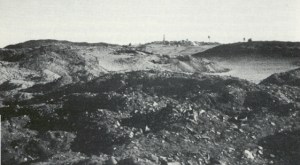 In particular, they feel, it would be politic to dump the works in their treasured family library on the town rubbish tip – including the copies of Aeschylus’ tragedies our cantankerous scribe had worked so hard to produce for them. Here, of course, the papyri will later be excavated in tattered strips by late nineteenth and early twentieth century archaeologists, beginning the painstaking process of piecing what little might remain of those texts back together…: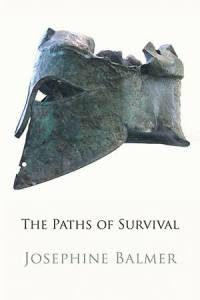


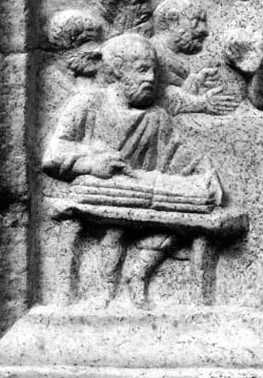 Scribes are the unsung heroes of the survival of any classical work; without them there would be no written papyrus texts and codices, and hence no fragments of drama or poetry. We know that scribes often worked from ‘scriptoriums’, maybe booths or workshops in city marketplaces where customers might request a work to be copied for their private libraries.
 In 1959, a previously unknown edition of the ninth century
  Photius’ Lexicon is not alone in surviving in the library of a Greek monastery; many works were taken to such safe places following political and religious upheavals in the east, for example after the sack of Constantinople by western soldiers during the so-called Fourth Crusade in 1204, as explored in an earlier post
  Photius I (later St Photius the Great) was a secular clerk who was appointed Patriarch (or Pope) of Byzantium in 858 following a time of often bloody religious schism in the city between the iconclasts, who wanted to destroy images of God as idolatrous, and the orthodox church, which viewed such depictions as holy relics. In 868 Photius was temporarily unseated but returned to the patriarchal throne in 877 when he continued his persecution of the city’s Jews.
 At the same time, Photius was revered as a cultured man whose classical scholarship was second to none. His Lexicon, probably written in his youth and revised later, contains many rare Greek words and their usage, including abdeluktos, an adjective meaning something like ‘absolved of blame’. Photius tells us the word originates in a line from Aeschylus’s lost play Myrmidons, probably from a scene in which the grieving hero Achilles caresses the body of his dead lover Patroclus. In recording it, this uncompromising Church father preserved perhaps one of the most controversial scraps of Aeschylus’s tragedy for the future. The following sonnet from my new collection
  The Paths of Survival